
Lead Generation Services for Real Estate Agents Explained
A newly licensed California agent can spend month after month paying for internet inquiries that never answer, never schedule, and never become clients. The vendor still delivers a report, the invoice still arrives, and the agent starts judging success by lead count instead of appointments and closed business.
That's the trap with lead generation services. They can create useful opportunities, but they can also turn a marketing budget into a recurring expense with no reliable connection to revenue. The right question isn't which service promises the most contacts. It's which acquisition mix gives an agent a defensible cost per lead, a workable follow-up process, and enough conversion potential to justify the spend.
The Lead Generation Decision Every Agent Faces
The scene is familiar. A freshly licensed agent in California wires $1,500 each month to a lead vendor because the sales representative promises a steady pipeline. The first delivery contains a flood of online inquiries. Several prospects don't remember submitting a form. Others already have an agent. Many never answer a call or text.
After several weeks, the agent's conversion ratio collapses while the charge remains fixed. The problem isn't necessarily a lack of effort. The vendor may be delivering shared contacts, old inquiries, weak intent signals, or prospects routed to several agents at once. A new agent can work every lead and still lose money if the source creates more follow-up labor than genuine opportunity.
The broader decision is unavoidable. Lead acquisition can be treated as:
- An expense line, where the agent buys activity and accepts uncertain results.
- An investment line, where every source receives a measurable return test.
- An owned system, where the agent builds an audience, database, website, and follow-up process that remains useful after an ad campaign ends.
The economics deserve attention because real estate lead generation is no longer a minor side expense in major markets. A 2026 industry survey reported a blended average cost per lead of $503, up 12.3% year over year from $448, with paid leads averaging $480 and organic leads $416. The same data set reported a median annual spend of $8,010 on lead generation and marketing, with about $2,850 per month directed to digital spend. Those real estate lead generation statistics show why agents need to compare sources rather than approve marketing budgets by habit.
Practical rule: A lead source earns more budget only after it proves that its contacts can move through the agent's follow-up process.
The options generally fall into four categories: IDX and portal leads, paid advertising, lead vendors and aggregators, and CRM systems with automation. Each category has different control, speed, quality, and ownership characteristics. Pricing may be per lead, subscription-based, hybrid, or tied to a completed transaction.
The useful comparison is not “How many leads arrive?” It's “What does each viable opportunity cost after qualification, follow-up, appointments, and conversion?” That lens protects agents from confusing cheap contacts with profitable acquisition.
What Lead Generation Services Actually Do
A lead generation service is a paid or platform-based system that helps deliver a prospective buyer or seller contact in exchange for advertising spend, subscription fees, referral fees, or a charge attached to each lead. Some services create demand. Others capture existing demand. Some only transmit contact details, while others score, route, and nurture prospects.
The first category is IDX and portal lead capture. An agent or brokerage website can invite visitors to register for listing alerts, saved searches, valuation information, or additional property details. A portal inquiry, such as a buyer asking about a listing on Zillow or Realtor.com, can then route to one buyer agent, a team, or a lead distribution system. The advantage is access to active search behavior. The trade-off is that portal visitors may compare several agents and may not remember the original inquiry.
Paid advertising creates a separate path. Google Ads can capture someone searching for a local real estate professional. Meta or YouTube can introduce a seller valuation offer to homeowners in a defined area. A Facebook campaign aimed at homeowners in the 92024 ZIP code, for example, can send clicks to a seller-focused landing page rather than a generic homepage. Agents running this channel should study practical guidance on how to optimize real estate Facebook ads, especially audience selection, creative testing, and conversion tracking.
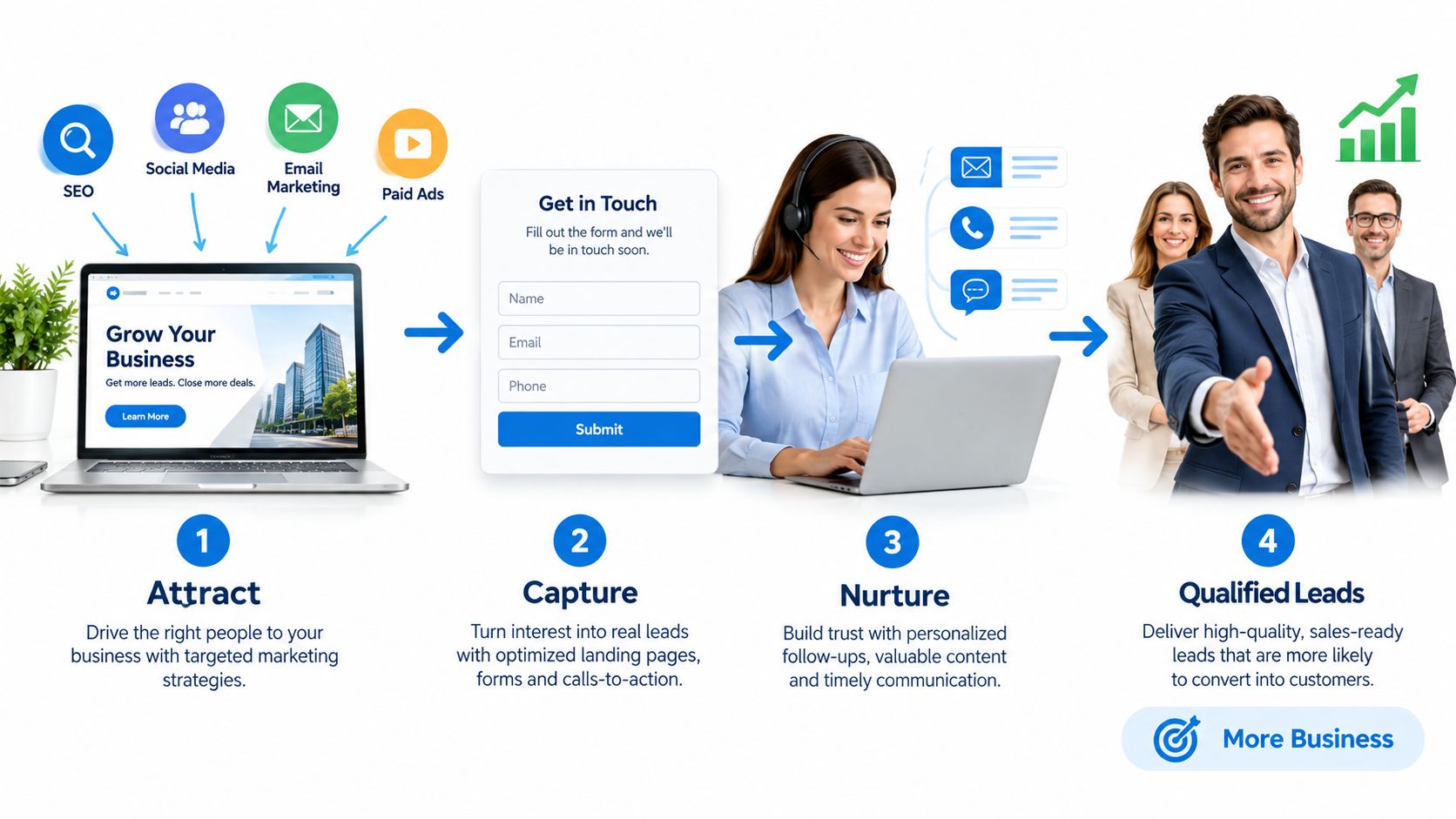
The source affects the work after capture
Lead vendors and aggregators sell contacts gathered from portals, online forms, outbound calls, or other digital properties. A vendor might offer a list of seller inquiries, but the age, exclusivity, consent history, and original action can vary. A contact's low purchase price doesn't make the lead economical if the inquiry is stale or has already been sold to multiple agents.
CRM and automation systems take a different approach. They generate, organize, score, and nurture contacts from an agent's own activity. An open house sign-in can enter a Follow Up Boss pipeline, trigger a text, assign a task, and place the contact into a longer nurture sequence. The system doesn't automatically create strong demand, but it can prevent a known prospect from disappearing into a spreadsheet.
The operational distinction matters. A vendor usually supplies access to contacts. An owned CRM process supplies continuity. Strong programs connect capture, qualification, routing, response, and measurement so an agent can tell whether a source produces business or merely produces notifications.
How the Main Pricing Models Work
Pricing models change the risk distribution between the agent and the provider. Per-lead arrangements place more risk on the agent because payment happens before conversion. Performance arrangements reduce the upfront burden but can claim a meaningful share of future commission income. Subscription and hybrid models sit between those positions.
| Pricing Model | Typical Cost Range | Example |
|---|---|---|
| Per lead | A fixed charge for each delivered contact | An agent pays for each buyer or seller inquiry, whether the contact responds or not |
| Retainer or subscription | A recurring monthly fee | A vendor provides platform access, campaign management, or a promised volume of delivery |
| Hybrid | A base fee plus usage charges | An agent pays for the system and then pays for qualified contacts or additional campaign activity |
| Performance or pay at close | A fee tied to a completed transaction | A referral network receives an agreed share of gross commission income after closing |
Per-lead pricing
Per-lead pricing looks simple because the invoice follows activity. The agent knows the charge associated with each contact and can compare sources at a glance. That clarity disappears when the service doesn't define what counts as a valid lead, whether the contact is exclusive, or how quickly the contact reaches the agent.
A low per-lead fee can be expensive if the agent must buy many weak contacts to find one serious conversation. A higher fee can be defensible when the lead is recent, localized, exclusive, and connected to a clear action.
Retainers and subscriptions
A retainer can make sense when the provider supplies strategy, creative production, campaign management, reporting, and technical support. It's a poor fit when the agent pays for a vague promise of exposure without a documented delivery process.
The contract should distinguish platform access from actual lead delivery. An agent may receive a refined dashboard and still have no reliable evidence that the service produces qualified opportunities.
Hybrid arrangements
Hybrid pricing can align ongoing support with campaign usage, but it requires close attention to caps and surcharges. The agent should identify the base service, included activity, definition of a qualified lead, overage rules, and treatment of duplicate or invalid contacts.
Performance pricing
Pay-at-close models defer much of the initial cost, which can help an agent protect cash flow. They also reduce control over the final economics because the fee is linked to commission income rather than the cost of generating a contact. Agents evaluating this option should review how referral fees affect net income alongside the brokerage's own policies. A separate explanation of real estate lead generation pay at closing can help clarify the structure.
Cost per lead is only the starting point. The true test combines lead cost with contact rate, appointment rate, conversion rate, follow-up labor, and the revenue retained after every referral or platform fee.
Comparing the Four Service Types Side by Side
Agents should compare each service by one business question: what does it cost to create a realistic chance of closing? The advertised cost of a contact is only the first input. A portal lead may arrive quickly but be shared. An organic inquiry may cost less at capture while requiring sustained content and SEO work. A CRM may not generate a new contact, yet it can increase the value of contacts already in the database.
| Service Type | Typical CPL | Lead Quality | Avg. Conversion | Best For |
|---|---|---|---|---|
| IDX and portals | Varies by platform, market, placement, and competition | Active search intent, but often shared or comparison-driven | Purchased online leads benchmark at about 0.4% to 1.2%; conversion benchmark data | Agents who need immediate inquiry flow |
| Paid ads | Depends on audience, offer, creative, and landing page | Can be localized and intent-specific when tracking is configured | Results vary widely by qualification and response process | Agents who can test campaigns and respond quickly |
| Lead vendors and aggregators | Depends on freshness, exclusivity, and source | Ranges from recent inquiries to aged or recycled contacts | Quality can be materially weaker when the vendor optimizes for volume | Agents with disciplined outbound follow-up |
| CRM and automation | No single contact price, because the system supports owned and existing sources | Higher visibility into history and behavior | Structured teams with dedicated intake roles can reach 5% to 10%, compared with roughly 1.5% to 3% for solo agents in the cited benchmark | Agents building repeatable nurture and routing |
IDX and portals
Portals can create fast activity for a new agent with little personal database. They work best when the agent responds immediately, understands local inventory, and separates casual browsing from an active move. Shared distribution limits control over the opportunity. Treat every delivered contact as shared unless the contract clearly promises exclusivity.
The economics also depend on follow-up capacity. A low-cost portal inquiry that receives one delayed message can produce less value than a more expensive lead handled promptly through a defined contact sequence.
Paid advertising
Paid ads give agents control over geography, message, offer, and landing page. A seller valuation campaign attracts a different motivation from a buyer search campaign, so combining both under one generic form weakens qualification. Agents should use separate campaigns when the audience, question, and next action differ.
This service type suits agents who can review search terms, creative performance, form quality, and downstream appointments. Set a spending limit, track the cost per appointment rather than only the cost per form, and stop campaigns that generate activity without conversations.
Vendors and aggregators
Vendors can fill a pipeline quickly, but they often create the largest follow-up workload. Require source transparency, recent activity, consent documentation, and a defined replacement policy for invalid data. Aged lists can still produce business, but they call for patient nurture rather than an expectation of immediate appointments.
Vendor leads belong in a portfolio, not as the entire acquisition plan. Cap the allocation until the source proves its contact rate, appointment rate, and retained revenue.
CRM and automation
CRM automation is less visible than buying new leads and often has greater operational value. It records the source, assigns ownership, triggers a rapid response, and prevents long-term prospects from receiving random communication. It cannot repair a weak offer or replace an agent who never calls, but it exposes those failures and makes follow-up measurable.
An in-house system can also change the cost calculation. Instead of paying a vendor for every opportunity, an agent may combine a CRM, owned audience, referrals, content, and brokerage support. Mentorship-based brokerages such as Ashby & Graff can be evaluated as an alternative to purchasing vendor leads, especially when guidance, accountability, and repeatable prospecting systems are included in the agent's operating model.
The broader benchmark is sobering. One 2026 report found an average lead-to-client conversion rate of 4.7%, meaning fewer than five of every one hundred leads became clients in that data set. The broader lead generation statistics review reinforces the practical lesson: measure what happens after delivery, not the size of the inbox.
A Practical Checklist for Evaluating Any Vendor
A vendor should answer operational questions before an agent discusses a contract. If the sales conversation focuses on projected lead volume but avoids exclusivity, routing, consent, and cancellation terms, the service is not ready for approval.
Start with lead quality
The first questions should concern the contact itself:
- Exclusivity: Is the lead delivered to one agent, one team, or several recipients?
- Freshness: What recent action caused the contact to enter the system?
- Verification: Does the service verify the phone number and email address?
- Intent: Does the record show a property inquiry, valuation request, appointment action, or only a broad form submission?
- Replacement terms: What happens when the information is invalid, duplicated, outside the service area, or clearly fraudulent?
Agents should also ask how the service defines a qualified lead. A vendor's definition may be a completed form, while an agent's definition may require a confirmed local need and a reachable contact. Those are different products.
Test the handoff
Response speed and routing discipline can determine whether a fresh inquiry becomes a conversation. The vendor should explain how quickly a new contact reaches the agent, whether an SMS or email is triggered, who receives after-hours inquiries, and what happens when the assigned agent doesn't respond.
CRM integration matters just as much. A lead that arrives by email and requires manual copying creates a double-entry problem. The agent should test whether the service can send source, timestamp, contact details, consent records, notes, and status updates into the existing CRM.

Review compliance and the contract
Privacy and outreach requirements deserve legal and operational review, especially in California. The agent should ask how the provider handles TCPA consent, do-not-call requests, privacy disclosures, data retention, and state-specific advertising requirements. The provider should identify which party carries responsibility for each step.
Email-heavy teams can also examine tools such as a service company email booking solution when they need a clearer way to organize replies and meeting requests. A booking workflow doesn't replace qualification, but it can reduce missed handoffs.
Before signing, the agent should document:
- Total commitment: Identify setup fees, minimum terms, automatic renewal, lead caps, and usage charges.
- Cancellation: Confirm notice requirements and the exact date when billing stops.
- Reporting: Require source, delivery time, contact status, appointments, and closed-business tracking.
- Pilot terms: Request a 30-day pilot with agreed KPIs before increasing spend.
The pilot should measure reachable contacts, qualified conversations, appointments, opportunities, and closed transactions. Lead volume belongs in the report, but it shouldn't be the success criterion.
When In-House Systems and Mentorship Win Instead
Buying leads isn't always the best use of an agent's marketing dollars. In the first 12 to 24 months, many agents are still learning how to qualify motivation, handle objections, conduct consultations, and follow up without sounding repetitive. A vendor can deliver contacts, but it can't automatically give an inexperienced agent the judgment needed to convert them.
That creates a costly mismatch. The agent buys more inquiries before mastering the process that turns an inquiry into an appointment. The vendor receives payment regardless of whether the agent's scripts, response timing, CRM stages, or consultation skills are ready.
An owned pipeline develops more slowly, but its assets remain with the agent. A personal website can support local search visibility. An IDX experience can capture property-search activity. A past-client and sphere database can create referral opportunities. CRM nurture can keep buyers and sellers engaged when they aren't ready to transact immediately.
Ownership changes the economics
The owned approach requires work. Agents must publish useful local content, maintain accurate contact records, ask for referrals appropriately, and build follow-up sequences that sound human. It also requires patience because organic visibility and relationship-based business don't arrive on the same schedule as a purchased lead.
The benefit is control. Agents choose the geography, message, form, database rules, and follow-up cadence. They can also see which relationships produce introductions rather than paying repeatedly for access to the same type of contact.
A purchased lead is rented attention. A database, reputation, and referral relationship are business assets.
Mentorship adds a third option. Instead of handing a new agent raw leads, a mentorship-based brokerage can help the agent build the conversion system behind those leads. Coaching may address prospecting habits, buyer and listing consultations, scripts, negotiation, local business planning, CRM use, and follow-up accountability.
That structure can matter more than another source of contacts. A broker-supported resource library and certified mentor can help an agent diagnose whether the core problem is lead quality or weak conversion behavior. The real estate mentorship program is an example of this kind of support model, where education and guidance form part of the agent's operating environment.
Choosing between the options
Vendor leads make sense when an agent already responds quickly, has spare follow-up capacity, and can track source-level profitability. In-house systems make more sense when an agent wants durable local visibility and has a database worth nurturing. Mentorship makes sense when the agent's biggest constraint is skill, structure, or accountability rather than a shortage of names.
A sensible portfolio can include all three, but the order matters. An agent who can't consistently process existing contacts shouldn't scale purchased leads. The first investment should strengthen the system that handles every source.
Choosing the Right Lead Strategy for Your Stage
The right lead strategy depends on your stage, capacity, and economics. A new agent may need a small, manageable flow of conversations and help improving response technique. A mid-career agent may need segmentation, automation, and clearer source tracking. An established producer may gain more from owned content, referrals, and database development than from another shared portal feed.
The decision is a portfolio choice. Compare each source by cost per lead, cost per appointment, conversion quality, and eventual commission. A cheap lead that consumes time without producing appointments is expensive. A higher-cost source can be sensible when the follow-up process converts it consistently.
New agents
New agents with limited budgets should select one accessible source and use it to practice the fundamentals. A portal feed or vendor program can create activity, but spending must stay fixed until conversion is demonstrated. Record every contact, respond consistently, and review conversations with a mentor or team leader.
Track the movement from contact to meaningful conversation, then from conversation to appointment. Total delivery is a weak measure on its own. If an agent cannot explain where a lead came from or what happened after the first call, that source should not receive more money.
Mid-career agents
Mid-career agents can combine paid advertising with CRM automation after identifying which offer attracts a real buyer or seller. Test a localized seller campaign, buyer search funnel, or market update separately. The CRM should assign source tags, trigger timely follow-up, and show whether prospects progress toward an appointment.
Track cost per lead, cost per appointment, and closed transactions by source. One channel may generate many inquiries while another produces fewer, stronger consultations. Budget should follow the source that creates profitable appointments, not the source that reports the largest contact count.
Established producers
Established producers usually have more to gain from improving owned systems than from chasing additional volume. Their sphere, past clients, local content, referral routines, and reputation can support a pipeline that depends less on recurring vendor fees. Brokerage mentorship and operational resources can improve those systems without replacing them.
| Agent Stage | Best Fit | Monthly Budget Range | Key Metric to Track |
|---|---|---|---|
| New agent | One controllable lead source plus coaching and CRM discipline | Limited and fixed until conversion is demonstrated | Qualified conversations and appointments |
| Mid-career agent | Paid campaigns combined with automation and source tracking | Moderate, divided across tested channels | Cost per appointment |
| Established producer | Owned database, local SEO, referrals, and selective paid acquisition | Flexible, based on proven return | Closed transactions and retained commission |
Review performance monthly, while allowing campaigns enough time for follow-up and nurture. The cited benchmark data reports 5% to 10% conversion for structured teams with dedicated intake roles, compared with roughly 1.5% to 3% for solo agents. The benchmark analysis shows why process design matters alongside source selection. Before changing vendors, audit response speed, routing, qualification, and follow-up coverage.
If two or three strategies stall, buying a fourth is rarely the answer. Audit each source, remove weak channels, repair the handoff, improve the consultation process, and scale only the strategy producing appointments and revenue.
Ashby and Graff offers California agents brokerage support, certified mentorship, training, business resources, and tools for building an owned lead pipeline instead of relying entirely on vendor contacts. Agents considering that model can visit Ashby and Graff to review its brokerage structure and available support.