Real Estate Mentorship Program Cost Breakdown
A new agent can spend weeks comparing brokerages, coaching packages, licensing courses, and marketing tools, then discover that the financial pressure isn't one large bill. It's the combination of every recurring cost arriving before the first closing. The real estate mentorship program cost matters, but it should be judged against the full launch budget, the brokerage split, and the amount of revenue the guidance can realistically help protect or create.
A premium coach isn't automatically a smart investment. A free training program isn't automatically cheap. The right question is whether the structure gives an agent enough practical access, feedback, and accountability to produce income without consuming the cash needed to operate the business.
Understanding Real Estate Mentorship Program Costs
A new agent with limited startup capital can spend $5,000 to $50,000 or more on a premium annual mentorship program before earning a commission. Lower-cost options exist, including free informal guidance, and one industry guide to real estate mentorship pricing places practical entry-to-midrange programs for newer agents and investors at $300 to $5,000 per year. The wide spread reflects different levels of access, feedback, and accountability, not just coaching quality.
A recorded course, weekly group call, and private deal review serve different business needs. Higher prices generally reflect greater mentor availability, closer involvement in decisions, and more responsibility for helping an agent execute.
The pricing spectrum
The main categories are:
- Online communities: Often about $100 to $600 per year, with recorded lessons, discussion spaces, and limited direct access.
- Group mentorship: Commonly around $1,000 to $10,000, including shared calls, peer learning, and structured assignments.
- Professional one-on-one coaching: Frequently listed at $5,000 to $25,000 per year, based on meeting frequency and personalization.
- Elite programs: Can exceed $30,000 annually, typically offering intensive access and individualized support.
These benchmarks come from the same industry guide cited above. Use them to compare offers, not to assume that a higher fee will produce a higher return.
Practical rule: Pay for a specific business constraint to be solved, not for the emotional promise of becoming successful faster.
An agent who needs scripts, transaction vocabulary, and basic prospecting structure may need only structured group support. An agent handling live negotiations, building a pipeline, and making costly operational decisions may justify direct review. Real estate mentorship program cost is defensible when the service intensity matches the problem and the expected improvement can cover the investment.
The first-year budget sets the correct test. Algonquin College lists its Real Estate Salesperson Program at approximately $4,795, a benchmark detailed later in this article. Licensing and training can consume substantial capital before private coaching begins, so mentorship belongs in the business plan alongside brokerage costs, marketing, and operating cash. It does not replace any of them.
Comparing Mentorship Pricing Models and Commission Structures
A new agent can conserve cash with “free” mentorship and still pay heavily through a commission split. Evaluate every offer by its true all-in cost, including upfront fees, surrendered income, brokerage charges, and the support needed to reach production.
Mentorship Pricing Models Compared
| Pricing Model | Upfront Cost | Long-Term Cost | Best For |
|---|---|---|---|
| Brokerage training | Free to about $250 per month | May include fees, required tools, or a commission split | New agents who need foundational support |
| Monthly coaching | Recurring monthly fee | Continues as long as access is needed | Agents who want flexibility and regular accountability |
| Flat-fee program | One defined payment or contract | Usually predictable, but access may end when the term ends | Buyers who want clear budgeting and defined deliverables |
| Revenue-share or split model | Often low or no separate coaching fee | A percentage of future commissions can become expensive as production grows | Agents prioritizing cash preservation at launch |
The Real Scout's real estate coaching guide outlines pricing benchmarks for brokerage training and coaching formats. Use those benchmarks to compare offers, not to assume that a higher fee will produce a higher return. A low-cost brokerage program can fit a limited startup budget, but review its agreement as carefully as a paid coaching contract.
A commission split is a real coaching expense. If a brokerage retains 20% of an agent's commission, the agent gives up $20,000 on $100,000 of gross commission income, before other fees. That calculation is arithmetic based on the stated split, not a market statistic. Apply the same calculation to your expected income and compare the agreement with commission structure examples before accepting “free mentorship.”
The trade-off between cash and ownership
Monthly coaching keeps the expense visible and predictable. A revenue-share model delays payment until income arrives, which can preserve cash during launch. Once an agent closes consistently, however, the surrendered percentage can exceed the cost of fixed-fee support.
A flat fee creates the opposite pressure. You pay before proving the return, but future production is not automatically reduced by the coaching contract. Choose this structure only when you have enough operating reserves and a specific plan for using the support.
The right model depends on production timing and available capital. A cash-strapped beginner can start with brokerage training, then buy targeted help for the first problem that blocks progress. An established agent with predictable production should question any permanent percentage paid for support that could be purchased at a fixed cost.
Questions the contract must answer
Before signing, confirm:
- Who provides the support: Is the named coach personally available, or does a sales representative transfer you to a junior trainer?
- What triggers payment: Does the split apply to every transaction, referrals, rentals, or only deals generated by the brokerage?
- How long obligations continue: Does the percentage end after a defined period, or continue until a termination condition is met?
- What happens after departure: Check for post-termination obligations, fee claims, or restrictions.
- What the agent receives: A training library is not equivalent to private contract review or live negotiation support.
Calculate the expected first-year cost before enrollment. Include licensing, marketing, brokerage charges, operating cash, and the income surrendered through a split. The cheapest entry price can produce the highest total cost when the obligation is vague or the support does not improve production. Choose the model whose measurable help can cover its full cost.
What Drives the Price of Real Estate Coaching
A new agent can spend heavily on coaching and still lose money if the program does not improve prospecting, conversion, or transaction decisions. Judge the fee against the full first-year cost of entering the business, including licensing, marketing, operating expenses, and brokerage splits. The right question is whether the support can produce enough additional income to cover those costs.
The lower-cost end
Brokerage or association training can range from free to about $250 per month, while group coaching commonly falls between $100 and $500 per month, according to Real Scout's coaching cost overview. These programs usually provide recorded lessons, group calls, script libraries, shared questions, and general accountability.
That structure suits a broad knowledge gap. A new agent learning prospecting routines, buyer consultation basics, or transaction terminology may not need private weekly access. The trade-off is limited diagnosis. A group coach cannot devote equal time to every pipeline, negotiation, or stalled deal.
The middle tier
Hybrid and cohort programs commonly cost around $400 to $1,200 per month. They combine structured coursework, live group sessions, and some individualized feedback. This tier fits agents who can execute independently but need a schedule, peer accountability, and occasional correction.
Focused education can reduce the need for expensive general coaching. For example, Virtual Tour Easy educational features offer resources for virtual property presentation and related workflows. Pay for that type of instruction directly when the gap is narrow. Do not buy a broad coaching package to solve one technical problem.
High-touch coaching
One-on-one premium coaching commonly starts near $750 to $1,000 per month and can exceed $3,500 per month, per the market comparison cited earlier. Private sessions, customized business planning, deal review, and direct feedback explain the higher fee.
A cited coaching comparison lists a Core plan at $749 per month for 24 private sessions per year and an Elite plan at $1,299 per month for 48 private sessions per year. Those prices annualize to approximately $8,388 and $14,488. Dividing the annual costs by the included sessions produces an approximate cost of $31 per Core session and $27 per Elite session, before valuing course materials or community access.
The expensive option isn't necessarily overpriced. The wrong access level is overpriced for the buyer's current problem.
Pay for private review when it changes a decision. Bring deals, numbers, scripts, or pipeline data to every session. Without that preparation, premium coaching becomes costly education consumption rather than performance support. That distinction determines whether the fee improves first-year ROI or merely increases the agent's startup burden.
Hidden First-Year Expenses Agents Often Overlook
Your first-year budget must fund the business, not just the coach. An agent who commits heavily to mentorship while underfunding licensing, association obligations, listing preparation, transportation, or prospecting has bought advice without paying for the work that turns advice into commissions.
Formal education can consume a large share of startup capital. Algonquin College lists its Real Estate Salesperson Program at approximately $4,795, as shown on the program's official fees page. This amount applies to the educational curriculum alone, rather than the full expense of starting a real estate career.
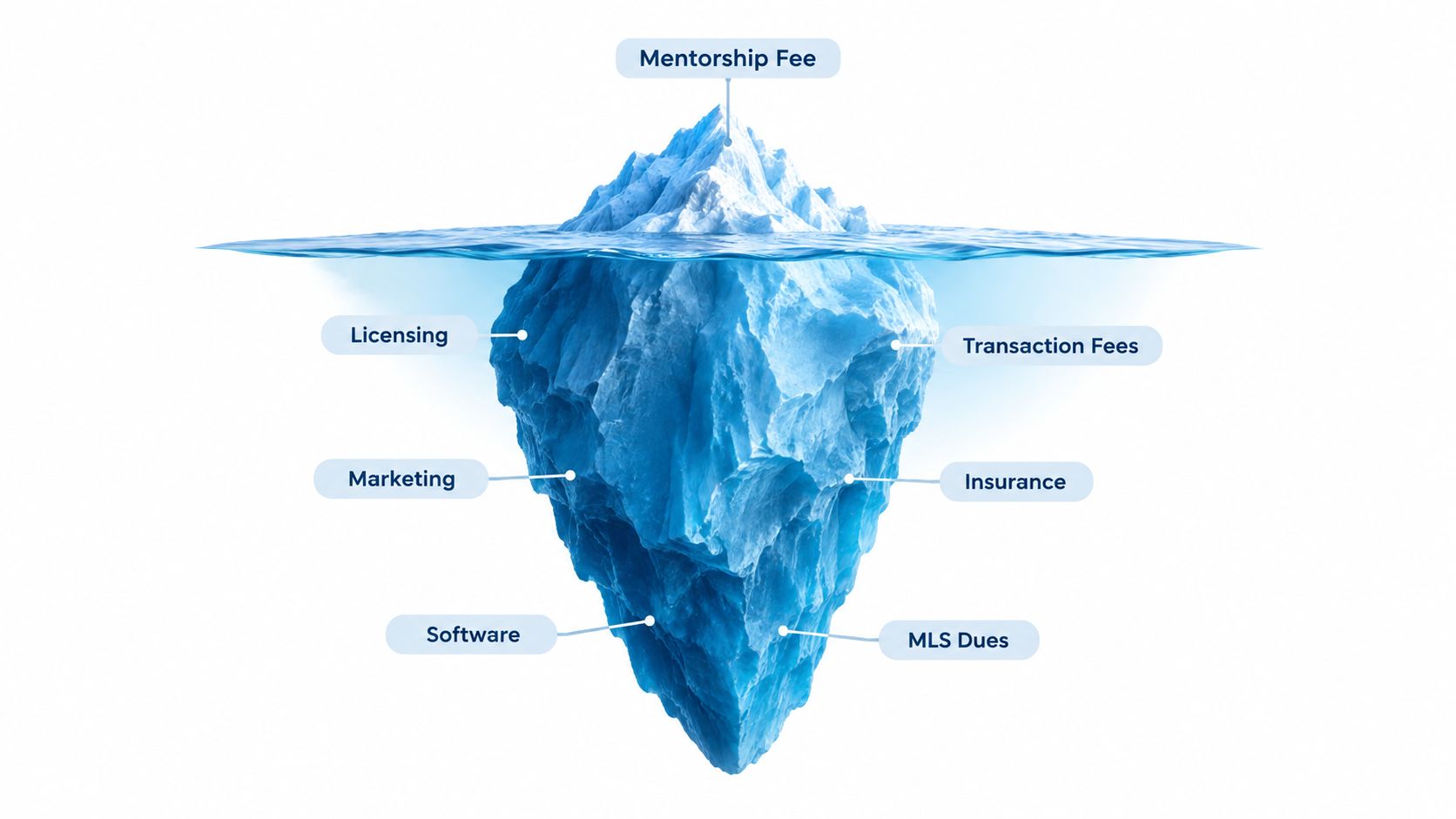
Costs beneath the coaching invoice
Build the first-year worksheet in three categories: required costs, operating costs, and optional investments.
- Licensing preparation and exams: These expenses come before you can operate as a functioning sales agent.
- Board and association dues: Membership may determine access to local systems and professional participation.
- MLS and technology fees: Search tools, transaction platforms, electronic signatures, and communication systems can create recurring charges.
- Marketing setup: Websites, photography coordination, print materials, signage, email tools, and advertising require funding before a listing generates income.
- Business administration: Bookkeeping, insurance, tax preparation, mileage tracking, and dedicated banking should be planned from the start.
Independent 2026 market sources estimate first-year licensing costs at approximately $390 to $1,175 or $500 to $1,500, before mentorship, according to the real estate agent expenses budget guide. Treat those ranges as location-dependent planning guidance, not a universal bill.
Protect operating capital after paying required costs. You need cash to keep prospecting, travelling, and serving clients if the first transaction takes longer than planned. Use this business expense tracking resource to separate fixed obligations from optional spending and identify where coaching is crowding out revenue-producing activity.
A better budgeting order
Pay licensing and compliance costs first. Fund basic operating tools next, then set aside money for lead generation and client service. Choose mentorship only after those commitments are covered, and select a fee you can sustain through a slow production period.
A premium program can provide useful guidance, but it cannot replace market activity. If its fee forces you to skip appointments, reduce outreach, or delay necessary technology, the program is consuming the resources that should generate its return. Evaluate mentorship by its all-in effect on first-year cash flow, not by the coaching invoice alone.
Calculating Your Personal Mentorship ROI and Break-Even Point
A mentorship fee earns its place in your budget only when it improves retained income or protects revenue you would otherwise lose. Calculate the result from your own transaction economics, not from the coach's marketing claims.
Break-even income = total mentorship cost ÷ net commission retained per transaction
Use net commission retained, not gross commission income. Brokerage splits, transaction charges, taxes, marketing costs, and other obligations determine what remains available to recover the program fee.
Example using a monthly fee
A program priced at $1,000 per month costs $12,000 over a year through simple annualization. If your transaction statements show $6,000 retained per transaction after brokerage deductions and direct deal expenses, the program must help create two additional transactions, protect equivalent income, or deliver a combination of benefits worth that amount.
That calculation sets a performance requirement. It does not promise production. Replace the assumed retained commission with the figure in your own transaction statements or written brokerage agreement, then account for the licensing, marketing, technology, and brokerage costs that already compete for your first-year cash.
A group program priced at $300 per month costs $3,600 annually. At the same assumed retained commission, it requires less additional or protected income to cover its fee. That lower break-even point reduces revenue exposure, but it does not make the program better. Choose it only if the format solves the specific gap limiting your activity.
Measure the service, not the sales pitch
Set a baseline before enrollment:
- Lead response: How quickly are new inquiries handled?
- Appointments: How many consultations are scheduled?
- Conversion: How many qualified conversations become active clients?
- Transaction quality: Are offers, inspections, and deadlines managed correctly?
- Time allocation: Are more hours going toward revenue-producing work?
Review those measures at regular intervals. A coach cannot control your discipline, market conditions, or client decisions. The service can still be judged by whether it improves preparation, reduces avoidable errors, and establishes a repeatable operating rhythm.
Use the published coaching comparison cited earlier as a utilization test, rather than repeating its package prices. If you attend only half of the sessions included in a plan priced at approximately $31 per session, your effective cost becomes $62 per attended touchpoint. That calculation exposes whether unused access is inflating your true cost. Apply the same test to any program with missed sessions, limited availability, or a commission obligation.
Your first-year ROI includes the opportunity cost. If mentorship consumes money needed for prospecting, client service, or required tools, the program must produce a stronger result to justify the tradeoff.
If the buyer can't name the behavior, decision, or revenue bottleneck the coach will change, the ROI case isn't ready.
A Practical Checklist for Evaluating Mentorship Programs
Treat a mentorship agreement like a business purchase. Before spending money or accepting a commission split, define what the program delivers, how the mentor works, and how the arrangement affects your first-year cash flow. The right program should support revenue-producing work without consuming the funds you need for licensing, marketing, reserves, and brokerage expenses.
Get the service in writing
Request a written program outline before enrolling. It should specify:
- Meeting format and frequency: Are sessions private, group-based, recorded, or mixed?
- Coach identity: Will the advertised mentor attend, or will another person provide the service?
- Response boundaries: Which communication channel should you use, and what questions fall outside the package?
- Deal review: Can the mentor review offers, disclosures, scripts, prospecting data, and transaction timelines?
- Materials: Are templates, call scripts, checklists, and recordings included, or sold separately?
“Support” is not a deliverable. Ask for a sample calendar, a typical coaching month, and the method used to document assignments, feedback, and follow-through. If the provider cannot describe a normal week, you cannot budget the service or judge its value.
Audit the full financial commitment
Read the contract before comparing headline prices. Check:
- Cancellation rights: Can you end the agreement without paying the remaining balance?
- Renewal language: Does access renew automatically?
- Refund rules: What happens if the coach becomes unavailable?
- Commission obligations: Does the program or brokerage receive a percentage of future income?
- Additional charges: Are onboarding, events, software, referrals, or advanced modules billed separately?
- Exit consequences: Does leaving the brokerage affect pending transactions or future commission payments?
A low monthly fee can become an expensive first-year commitment if it includes an indefinite commission split, mandatory extras, or costly cancellation terms. Calculate the likely total from enrollment through the first closing, then compare it with the cash required for prospecting and client service.
Confirm the mentor fits your business
Match the mentor's experience to your work. A residential buyer agent needs different guidance from an investor, commercial specialist, or luxury listing professional. Ask how the program addresses your market, prospecting channels, transaction type, and current skill level.
Protect your runway
Choose the structure your budget can sustain. Group coaching may cover foundational skills. Private coaching earns its higher cost when you face live negotiations, transaction decisions, or problems that require individualized judgment.
Before signing, write down the first week's actions, the first month's outputs, and the review date for deciding whether to continue. Keep enough capital for licensing requirements, marketing, software, and reserves. A mentorship program deserves more of your startup budget only when its access and guidance justify the opportunity cost. If it offers inspiration without a practical operating plan, do not buy it.
The Ashby and Graff Approach to Agent Success and Mentorship
Your first-year budget must cover more than coaching. Licensing, marketing, software, client service, reserves, and brokerage costs all compete for the same cash. A brokerage model that includes training and broker support can change the true all-in cost of mentorship by leaving more commission available for the activities that produce closings.
Ashby and Graff describes a California brokerage model with zero broker splits, no hidden fees, flexible commission plans, certified mentors, training, and business-planning resources. Its stated service areas include Los Angeles, Orange County, San Diego, and the San Francisco Bay Area. The company also describes direct payment at escrow and transaction support, which may reduce administrative work and make cash planning easier. Review the terms yourself before treating those features as part of your financial plan.

Why the structure matters
A brokerage that retains no percentage of an agent's commission can leave more income available after each closing. The savings do not eliminate transaction or operating costs, and the arrangement does not make mentorship free. It gives you another way to fund marketing, continuing education, software, or targeted coaching from retained earnings instead of paying a large coaching fee before revenue exists.
This structure fits agents who want organized broker support without trading an indefinite commission percentage for training. It can also suit experienced agents who know which skills need improvement and can buy focused help rather than a broad coaching package.
What agents should confirm
Verify the current fee schedule, mentor availability, transaction support process, technology requirements, local compliance duties, and every condition attached to flexible plans. Details can change. The written agreement controls your decision.
Use a brokerage model that protects cash for prospecting and client service. Avoid indefinite revenue-sharing obligations when a fixed structure provides the support you need. Choose Ashby and Graff only after comparing its full first-year cost with licensing, marketing, reserves, and any separate education. Mentorship earns its place in your budget when you can apply the guidance and connect it to revenue.
Review the current model and support options through Ashby and Graff before committing first-year capital to a separate coaching contract.