Listing Agreements Real Estate Agents Must Master
A listing agreement is the written contract authorizing an agent to represent and market a seller's property, and the exclusive right-to-sell form is the industry norm in many residential markets. Under that form, the seller owes the agreed compensation if the property sells during the listing term, regardless of who finds the buyer.
A newly licensed California agent often learns the true weight of that definition at the first listing appointment. The seller is ready to sign, the pricing conversation has taken an unexpected turn, and a stack of contract pages sits between a promising relationship and months of professional responsibility. A rushed signature can create compensation disputes, unclear authority, weak cancellation rights, or an MLS problem that surfaces only after the listing is active.
A listing agreement isn't administrative paperwork. It establishes who represents the seller, what the brokerage is authorized to do, how compensation is triggered, how long the relationship lasts, and what happens when the relationship ends. The agent who understands those mechanics protects the seller and the brokerage at the same time.
Why Every Agent Must Understand Listing Agreements
At a first listing appointment, the seller may focus on price, photography, and how quickly the home can reach buyers. The agent is managing a different question: can the signed agreement support the work, compensation, and MLS activity that follow? A confident presentation still requires enough time to explain the contract that governs the relationship.
A common failure begins when the agent gives the marketing plan most of the attention and leaves the agreement for a rushed signature. The seller may not understand what triggers compensation, what authority the brokerage receives, or what happens if the seller finds a buyer independently. The dispute often appears later, after the agent has invested time and the seller believes the sale should bypass the brokerage.
The document behind the business
The National Association of Realtors consumer guide to listing agreements describes the listing agreement as the contract that authorizes an agent to represent and market a property. It also explains the exclusive right-to-sell structure, in which the seller owes the agreed compensation if the property sells during the listing term, regardless of who finds the buyer.
For the agent, that structure is more than a commission provision. It supports a defensible plan for marketing, pricing advice, negotiations, and MLS participation. The brokerage can commit resources without leaving the compensation question open at the final step. Earlier, less formal brokerage arrangements often created disputes because the parties had not clearly recorded what the broker could do or when compensation had been earned.
The agreement allocates three forms of risk for the agent, and each one determines how defensible the file is months from now:
- Compensation risk: The contract identifies the event that creates the seller's payment obligation and the terms that apply if a transaction develops.
- Compliance risk: The file must show authority, required disclosures, agency choices, signatures, and dates clearly enough to support the brokerage's conduct.
- Operational risk: The agreement sets the boundaries for marketing, property placement, MLS participation, and the end of the brokerage's authority.
A useful test is simple: if the seller cannot explain what the agent may do and when compensation is owed, the agreement has not been explained well enough.
That standard affects every later decision. The contract type can strengthen or weaken compensation protection. Individual clauses can expose the agent to avoidable disputes. California requirements add documentation responsibilities, while negotiated terms determine whether the written promise matches the service plan. Sloppy drafting does not stay on the page. It can limit MLS participation, complicate a cancellation, and make an ordinary closing harder to defend.
What a Listing Agreement Actually Does
A useful analogy is a professional marketing retainer. The seller hires a brokerage to position the property, expose it to potential buyers, manage inquiries, and guide the transaction. In return, the brokerage receives defined authority and a contractual path to compensation.
The analogy matters because a retainer isn't permission to do anything without limits. The agreement should tell the agent what the seller has authorized and tell the seller what the brokerage has undertaken to do.

Five details that make the relationship workable
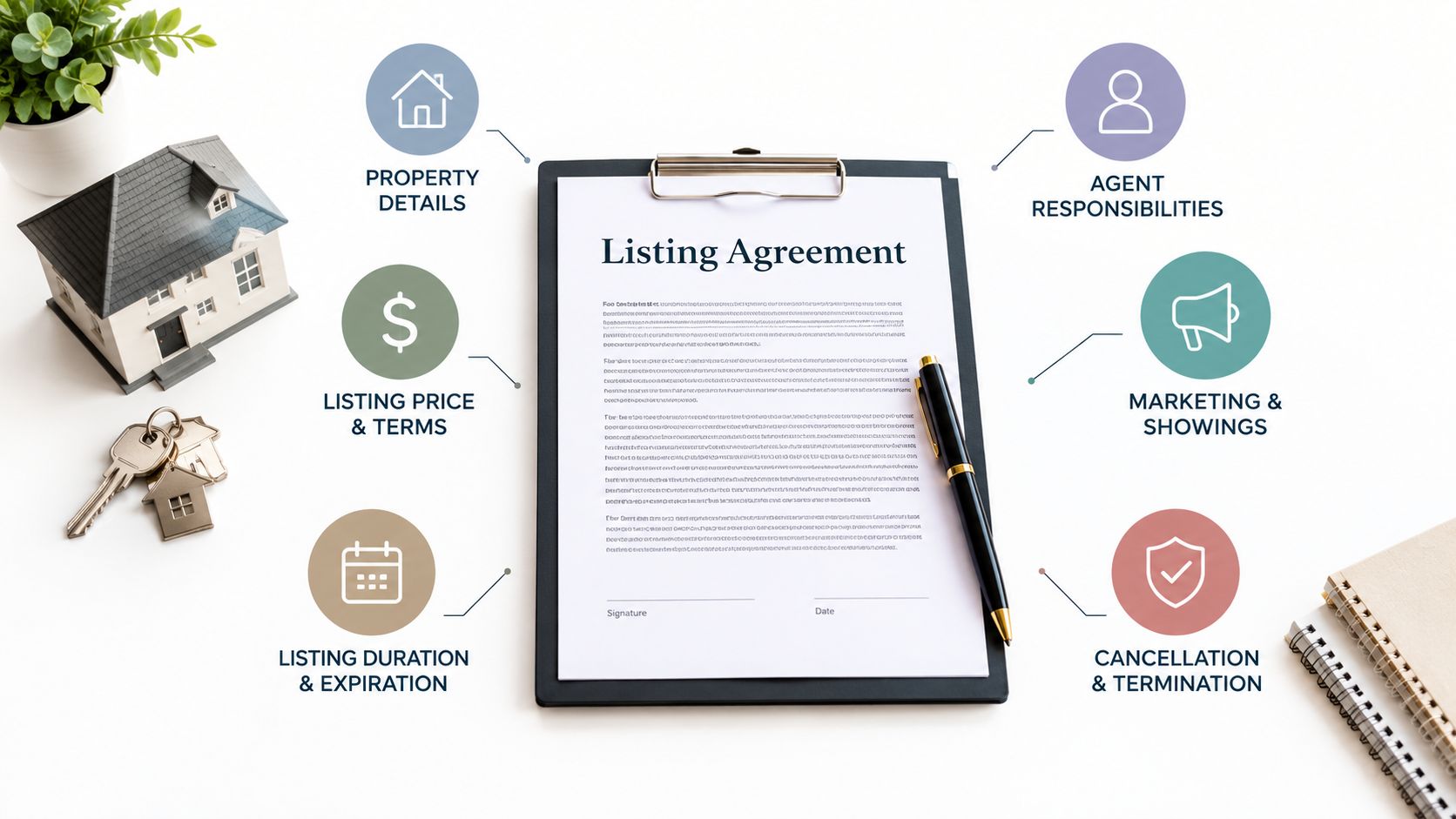
Modern listing forms typically identify an exact listing price, effective date, expiration date, and the broker's compensation terms, as described in this listing agreement overview. Each detail answers a practical question.
- Listing price: What price is the brokerage authorized to advertise?
- Effective date: When does the agency and marketing authority begin?
- Expiration date: When does the agreement end unless the parties extend or replace it?
- Compensation terms: What amount or method determines the brokerage's compensation, and what event triggers payment?
- Agency scope: Is the relationship exclusive, nonexclusive, or subject to other agency arrangements disclosed in the form?
The seller should also understand the service promise behind the signature. If the agent discusses photography, MLS entry, digital distribution, showing coordination, or negotiation support, the written agreement and related brokerage documents should align with those representations. A vague promise creates room for disagreement, while a clearly described service scope gives both sides a workable standard.
Why written authority matters
Real estate professionalized through the late nineteenth and twentieth centuries. Written forms became more important as organized real estate boards and MLS networks developed, because brokers needed documented seller authorization and predictable cooperation rules. A handshake might communicate trust, but it can't reliably establish the listing price, term, compensation, or authority required for a modern marketing system.
Agents who need to turn dense transaction documents into clearer client explanations can also review a real estate PDF video tool as a resource for presenting documents in a more accessible format. The tool doesn't replace broker review or legal advice. It can support the communication task, especially when a seller needs the agreement explained page by page.
A one-minute explanation should sound simple: the seller authorizes the brokerage to market the property under stated terms, the brokerage performs the agreed services, and the compensation clause explains when payment is due. Everything else gives that basic promise precision.
Comparing the Five Types of Listing Agreements
The agreement type determines how much compensation risk the agent accepts. It also affects whether the brokerage can confidently invest in marketing, how the seller can work with other parties, and what happens if the seller finds the buyer without the listing agent.
Listing Agreement Types at a Glance
| Agreement Type | Exclusivity | When Commission Is Owed | Best Fit |
|---|---|---|---|
| Exclusive right-to-sell | One brokerage receives exclusive authority | When the property sells during the term, regardless of who procures the buyer | A seller seeking full-service representation and a brokerage prepared to market actively |
| Exclusive agency | One brokerage has the exclusive agency relationship, while the seller may retain a self-sale option | When the brokerage procures the buyer under the agreement | A seller who wants one brokerage involved but wants to preserve a defined self-sale option |
| Open listing | No single brokerage has exclusive control | When the participating broker's efforts produce the sale, subject to the written terms | A seller prioritizing flexibility and accepting less compensation certainty for each broker |
| Net listing | Compensation is tied to an agreed amount above the seller's target | When the transaction produces the contractual net result, subject to applicable rules and brokerage approval | A situation requiring heightened review because the compensation structure can create conflicts |
| MLS entry-only | The brokerage's role is limited to an agreed listing or entry service | According to the narrow written service and compensation terms | A seller prepared to handle much of the marketing, showings, and negotiation independently |
The exclusive right-to-sell agreement is the most broker-protective structure. The NAR policy definitions explain that the seller owes compensation even when the seller, another broker, or another party procures the buyer. That independence from the buyer's source reduces compensation uncertainty and can support broader marketing and MLS participation.
Matching structure to the seller
An exclusive right-to-sell agreement usually fits a seller who wants a single accountable team and expects the brokerage to invest in pricing, exposure, showing management, and negotiation. The agent must still explain the commission trigger plainly. “Exclusive” doesn't mean the seller loses all decision-making authority. It means the brokerage's right to compensation is not dependent on personally locating the buyer.
Exclusive agency sounds more flexible because the seller may retain a self-sale option. That flexibility carries a direct tradeoff for the agent. If the seller finds the buyer, the brokerage may perform substantial work without receiving compensation, so the service scope and seller's responsibilities require careful explanation.
An open listing permits multiple brokerage relationships, with compensation generally tied to the broker whose efforts produce the sale under the contract. It may suit a seller who wants maximum freedom, but it gives each agent less incentive to commit resources. Private or limited-marketing arrangements deserve the same scrutiny, especially when the seller assumes that every listing receives the same exposure. A discussion of private real estate listings can help agents frame that difference for clients.
Net listings and MLS entry-only arrangements require extra caution. A net structure can make the agent's financial interest appear too closely connected to the seller's minimum outcome, while an entry-only arrangement can leave sellers surprised by how much work remains after the listing is entered. The contract type should match the service being delivered, not the seller's desire for a lower apparent commitment.
Key Clauses That Shape Every Listing Contract
A seller calls Tuesday afternoon asking for a price change. Another broker submits an offer, then the seller asks to cancel before the listing expires. The agreement type sets the broad relationship, but the clauses determine what the agent may do, what the brokerage may collect, and how much compliance risk sits in the file.
Read every clause as a risk-allocation device. Ask two questions: what does this sentence require, and who carries the risk if the transaction changes? That approach also clarifies whether the brokerage has authority to market, update the MLS, cooperate with other brokers, and claim compensation.
Term and expiration
The term identifies the period of authority. Consumer education commonly describes a listing term as about six months, a defined marketing window rather than an open-ended relationship, as explained in the NAR consumer guidance. The exact term remains a negotiated contract decision, not a number to insert automatically.
Treat the expiration date like a closing deadline. A vague endpoint can create uncertainty about a final offer, pending escrow, or a buyer who appears after expiration. Holdover or protection language should state which event activates it and how it applies to buyers the brokerage procured. If that language is unclear, compensation and post-expiration compliance questions can surface at the same time.
Compensation and cooperation
The compensation clause should identify the agreed amount or method, the party responsible for payment, and the event that makes payment due. It should also address any separate buyer-side compensation, seller concessions, or cooperation terms. Those details affect the agent's compensation risk and the brokerage's conversations with other participants, so they should not be left for closing.
Read the compensation clause as if the seller has never worked with an agent. If the payment trigger cannot be explained without jargon, the clause needs a clearer conversation.
Agency, termination, and exclusivity
Dual agency provisions require candid disclosure and careful handling where permitted. The seller should understand what changes when one brokerage represents more than one side, while the agent follows approved forms and the brokerage's review process.
Termination language controls whether either party can end the relationship early, what notice is required, and which rights survive. Exclusivity language must match the selected agreement type. Indemnification language assigns responsibility for particular acts or losses, so it should not be dismissed as harmless boilerplate.
State law can make these clauses more technical than a brokerage policy. Oregon's rules illustrate how far state requirements can reach. Its 2024 overview addresses a written listing agreement before marketing, an expiration date, disclosure of whether the agreement is exclusive or nonexclusive, signatures, and a term not exceeding 24 months. It also addresses clauses that could require duplicate commissions after expiration or mutual termination, according to the Oregon Real Estate Agency overview. California has its own documentation expectations, which makes the same clause review necessary for a California agent.
Agents building a disciplined file can use this guide to review real estate contracts. Broker review belongs before a questionable clause reaches the seller, not after a dispute gives the wording practical significance.
California Rules and Best Practices for Agents
California agents operate in a disclosure-heavy environment where the safest habit is documentation before action. The listing appointment may feel conversational, but the authority to market the property, the identity of the clients, and the compensation arrangement should be recorded in approved written forms.
A new agent should make broker review part of the listing process rather than a rescue step. The supervising broker or transaction team can identify missing signatures, inconsistent dates, unclear compensation language, and agency disclosures that don't match the proposed relationship.
A California compliance mindset
The following practices help keep the file defensible:
- Confirm ownership and authority: Every person whose interest requires consent should be identified and handled according to brokerage procedures. A single confident signer shouldn't automatically be assumed to speak for every owner.
- Deliver agency disclosures properly: The seller should receive the required explanations and disclosures at the appropriate stage, in language that matches the actual relationship.
- Document compensation clearly: The listing side, any proposed cooperation, concessions, and variable-rate or dual-agency arrangements should be explained rather than implied.
- Use approved forms: An agent shouldn't edit legal language casually or copy a clause from an old transaction because it “worked last time.”
- Keep the file complete: The executed agreement, disclosures, amendments, communications, and termination documents should remain together.
Compensation terms are becoming more visible and more negotiation-driven. The agent must explain who may pay whom, what the seller may agree to contribute, and how the arrangement affects the seller's transaction decisions. The conversation should stay factual and avoid presenting any compensation outcome as automatic.
Ethics protects the contract
Equal and honest service isn't separate from contract compliance. An agent who promises a listing price merely to win the signature creates pressure for later reductions. An agent who advertises services that aren't available creates a service dispute. An agent who hides a dual-agency implication invites a trust problem that no clause can easily repair.
Legal questions deserve qualified legal guidance, especially when ownership, cancellation, indemnification, or unusual compensation arrangements are involved. A practical resource on how to choose a business contract lawyer can help an agent understand what to look for when a brokerage refers a client for independent counsel.
Broker support also matters. Mentorship gives a newly licensed agent a second set of eyes before execution, while structured training turns the listing agreement from a form into a repeatable process. The goal isn't to make every agent a lawyer. The goal is to ensure that every agent knows when the form is routine, when broker review is essential, and when the client needs independent legal advice.
How to Negotiate Listing Terms With Confidence
Confident negotiation starts before the seller asks for a concession. The agent should know which terms protect the brokerage, which terms improve the seller's flexibility, and which changes require broker approval.
A common listing term of about six months gives the brokerage a defined window for marketing, pricing adjustments, and negotiation, as described in NAR consumer education. It shouldn't be presented as an unchangeable rule. The appropriate term depends on the property, the marketing plan, the seller's circumstances, and the brokerage's policies.
The conversation at the listing table
The agent should explain the exclusive right-to-sell commission trigger with a direct example: if the seller personally finds the buyer during the term, the seller may still owe the agreed compensation under that structure. That explanation prevents the seller from confusing exclusive representation with a promise that payment occurs only when the listing agent personally introduces the buyer.
The agent should also separate services from compensation. A seller may ask for a different fee, narrower marketing, a shorter term, or defined cancellation language. The response should connect each requested change to the work the brokerage can responsibly provide. Compensation discussions also need to address seller concessions and any separate buyer-side arrangement without implying that one party's payment is guaranteed.
Signing-day checklist
Before anyone signs, the agent should verify:
- Parties and authority: All required sellers are identified, and signing authority is documented.
- Price and property: The legal property description and authorized listing price are accurate.
- Dates: The effective date and expiration date are specific and consistent.
- Compensation: The amount or method, payment responsibility, and trigger are understandable.
- Agency choices: The form accurately reflects exclusivity and any dual-agency disclosure.
- Service scope: Promised marketing and transaction services match the written commitment.
- Termination terms: Cancellation rights, notice requirements, and surviving provisions are clear.
- Signatures and delivery: Every required signature is obtained, and the executed copy is delivered and retained.

A strong agent doesn't negotiate by apologizing for the contract. The agent explains what each term accomplishes, identifies what can be adjusted, and pauses when a requested change needs broker or legal review. Sellers usually respond better to a clear explanation of tradeoffs than to vague assurances that “this is just the standard form.”
Common Mistakes to Avoid With Listing Agreements
Most listing disputes begin with a conversation that never happened. The following mistakes are preventable with a few disciplined habits.
- Skipping the commission trigger: The seller believes a self-found buyer eliminates compensation. The agent should explain the exclusive right-to-sell trigger with a plain example before signature.
- Leaving dates ambiguous: An agent focuses on the launch date and overlooks expiration. The prevention habit is to read both dates aloud and calendar the end of the term.
- Promising more than the form supports: “Full marketing” means different things to different sellers. The agent should write the service scope with enough detail to match the actual plan.
- Ignoring termination language: The issue stays invisible until an unhappy seller asks to leave. The agent should explain notice, cancellation, and surviving rights at the start.
- Reopening compensation too late: A seller negotiates concessions and discovers that the original assumptions no longer fit. The agent should revisit the economics whenever the transaction structure changes.
A complex ownership or compensation disagreement may justify advice from a qualified Los Angeles real estate lawyer, rather than an improvised answer from the agent. Legal referrals protect the client and keep the agent within the proper professional role.
Mastering Contracts to Build Your Real Estate Career
A capable listing agent follows a clear progression. The agent understands what the agreement authorizes, matches the contract type to the seller's situation, reads each clause, follows California disclosure practices, negotiates without overpromising, and documents the final relationship carefully.
That discipline builds more than a clean transaction file. It gives sellers confidence, reduces avoidable disputes, and helps the agent create a business based on repeatable professional conduct rather than last-minute problem solving. Mentorship and structured training shorten the learning curve because a new agent can review real decisions before making them alone.
A brokerage relationship should support that standard with accessible broker guidance, practical contract training, transaction resources, and a compensation plan the agent can understand. The next listing appointment becomes less intimidating when the agent knows which questions to ask and which clauses deserve a pause.
Agents seeking hands-on support with listing agreements, transaction processes, negotiation, and career planning can visit Ashby and Graff. The brokerage offers mentorship, training, flexible commission plans, and guidance designed to help California agents handle contracts with greater clarity and confidence.