7 Negotiation Training Courses for Real Estate Agents
A buyer's agent is facing a multiple-offer situation. The listing side wants the strongest terms, the buyer wants protection, and every concession affects the client's position. In another transaction, an inspection dispute threatens to derail the deal, while a fee conversation tests whether the agent can explain value without becoming defensive. These moments don't reward memorized theory. They demand preparation, emotional control, precise questions, and enough practice to respond under pressure.
The strongest negotiation training courses differ in their real estate relevance, practice intensity, delivery format, pricing transparency, provider credibility, and suitability for an individual agent, team, or brokerage. Research also supports looking beyond course completion. A meta-analysis covering 17 studies, 20 samples, and 44 effect sizes found a large overall training effect of g = .72, with longer programs producing stronger results than shorter ones, although outcomes varied across studies (IAFCM conference research). Agents evaluating how to build a training programme should therefore compare practice and reinforcement, not just certificates. Ashby & Graff's internal training and mentorship resources can also suit agents who want negotiation support inside a brokerage environment, separate from the external programs ranked below.
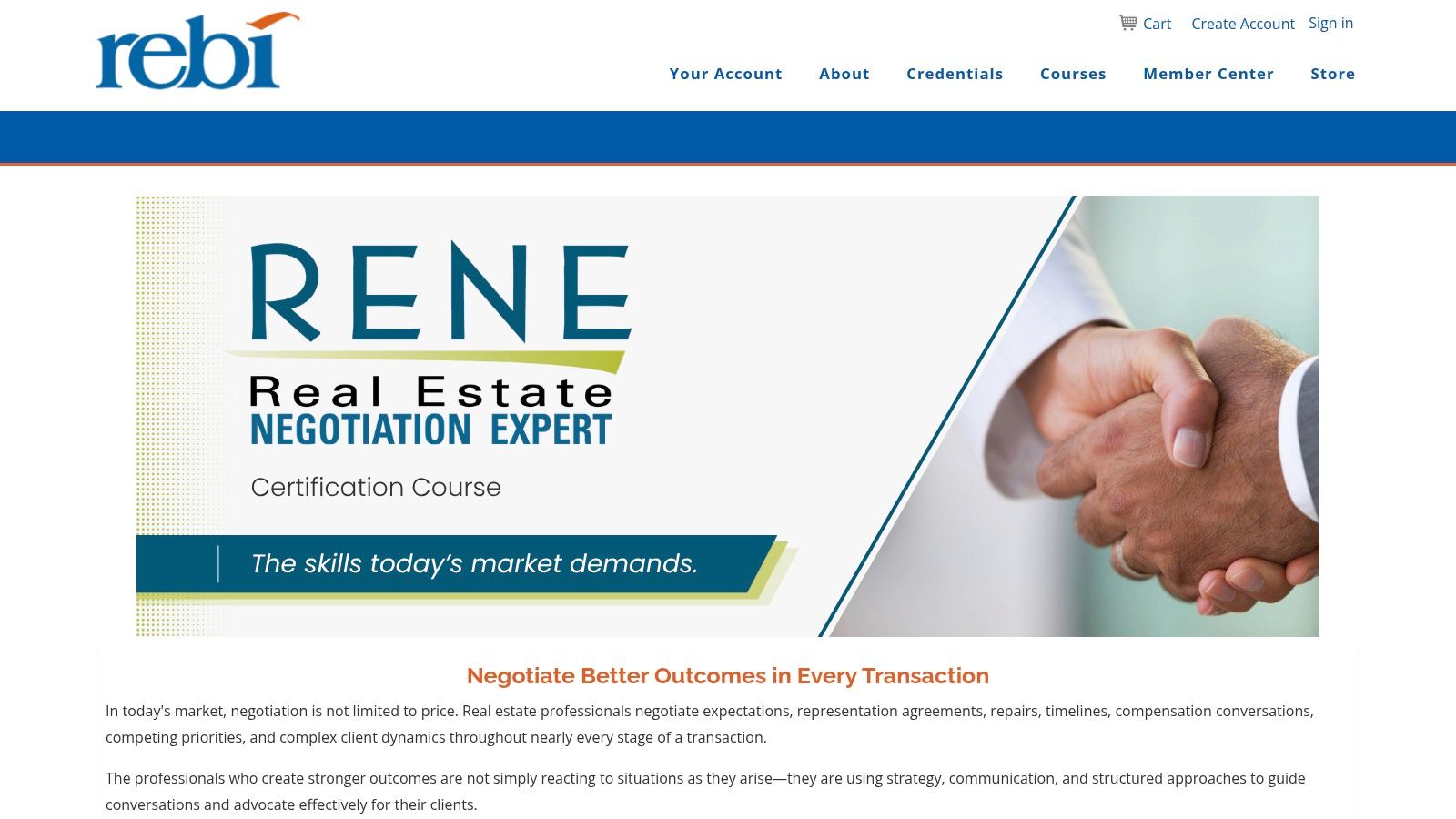
1. Real Estate Negotiation Expert RENE from REBI
RENE is the clearest choice for an agent who wants real estate-specific negotiation instruction with a recognized credential. The two-day course is designed for REALTORS® and addresses preparation frameworks, multiple-offer strategy, difficult counterparts, client advocacy, and ethics. That focus matters because the exercises and language are more likely to resemble listing presentations, inspection responses, offer terms, and cooperating-agent conversations than examples drawn from general corporate purchasing.
The program is delivered through local associations in classroom and live-online formats, with continuing education credit often available. Local delivery makes enrollment practical for an individual agent, while a brokerage can encourage several associates to attend through the same association or provider. The credential is recognized through NAR and REBI, which can add a useful signal when an agent presents qualifications to clients or professional contacts.
The buying decision
- Transaction relevance: Excellent for buyer and listing negotiations, multiple offers, difficult counterparts, and ethical client representation.
- Practice intensity: Practical scenarios and scripts provide a strong starting point, but the two-day format shouldn't be treated as complete mastery.
- Pricing transparency: Tuition is set by the local association, so buyers should confirm the full enrollment cost and the separate credentialing process before registering.
- Individual, team, or brokerage: Best for an individual agent seeking a structured foundation, though teams can use the course as a common baseline.
The main trade-off is consistency. Local instructors and delivery conditions can shape the experience, and lasting improvement requires deliberate practice after the course. Agents who want to strengthen that transfer can pair RENE with resources for developing negotiation skills and regular mentor feedback.
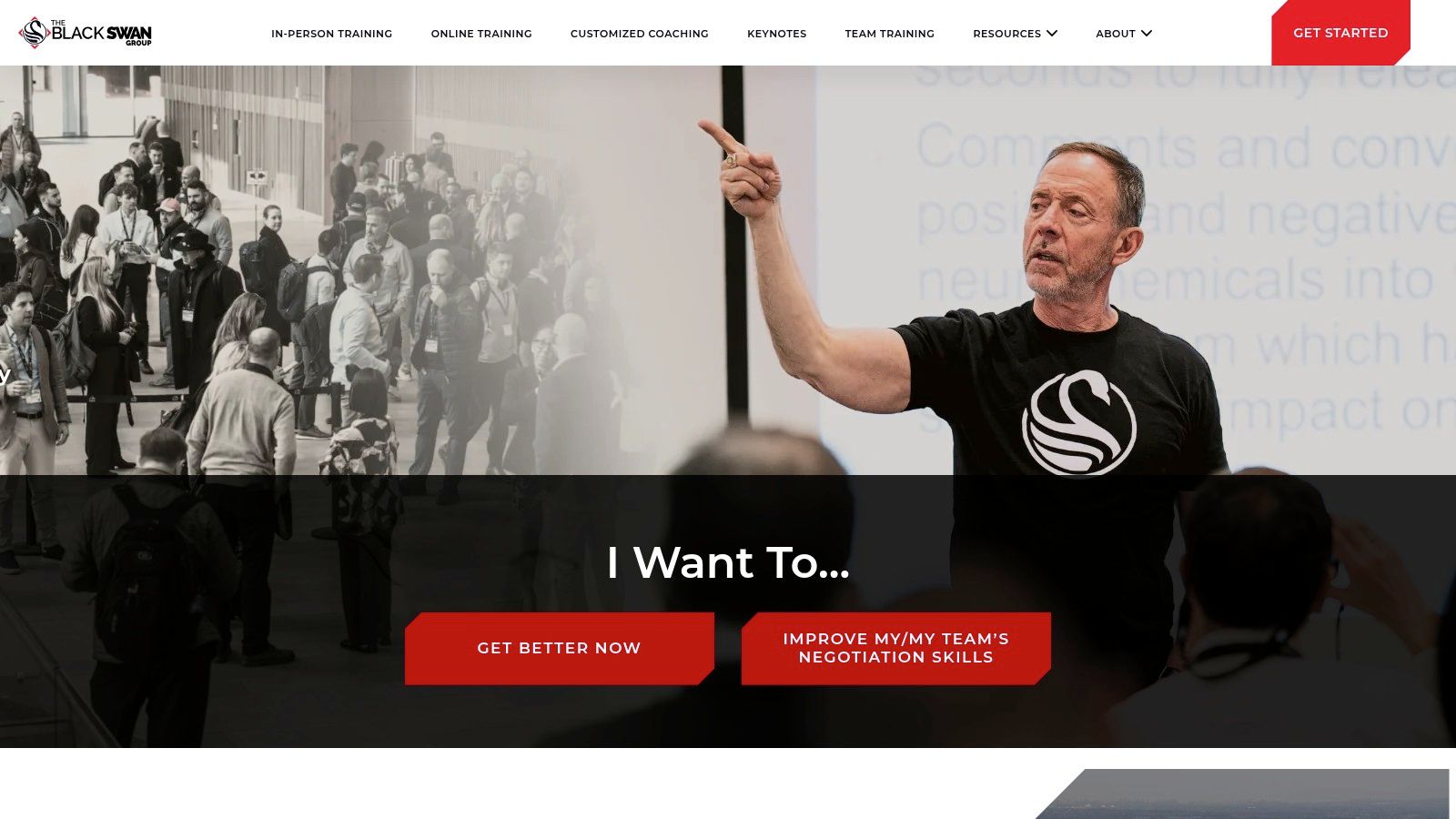
2. The Black Swan Group from Chris Voss
The Black Swan Group is built for the conversation that starts going sideways. Its approach draws from FBI hostage-negotiation methods and emphasizes Tactical Empathy, calibrated questions, labeling, emotional control, and uncovering information that the other side hasn't stated openly. Those tools can translate well to an angry seller, a defensive buyer, a difficult listing agent, or a negotiation where the stated objection doesn't explain the obstacle.
The provider offers corporate workshops, public events such as Dealmaker Days, online courses, and a Negotiation Mastery Summit. The variety gives an individual agent a way to begin independently, while a brokerage can commission a private workshop for a larger group. Role-play and coaching are especially important here. The techniques are language-based, so agents need practice using them naturally rather than repeating phrases mechanically.
Where it fits in real estate
A fee discussion can benefit from calibrated questions that invite the client to explain concerns. An inspection dispute may require labels that acknowledge frustration without conceding the client's position. A multiple-offer conversation can benefit from controlled questions that reveal priorities instead of assuming price is the only issue.
The brand is strong, but pricing for corporate programs often isn't published, and premium public events may not suit every budget. One-day formats can also provide less repetition than an agent needs for durable behavior change. A buyer should ask how much live practice, individual coaching, and feedback are included before choosing an event.
Practical rule: Choose the format with the most relevant practice, not simply the most recognizable name.
The Black Swan Group is best for an individual agent who wants immediately usable communication techniques or a team handling high-emotion transactions. Brokerages should request a detailed scope that connects the exercises to listing, buyer, inspection, and compensation conversations.
3. KARRASS Effective Negotiating
KARRASS takes a traditional seminar approach and makes it useful through structure and rehearsal. Its two-day Effective Negotiating program focuses on preparation, trading variables, concession strategy, and mock negotiations. That framework maps naturally to real estate, where an agent may trade price against timing, repairs against credits, possession against certainty, or contingencies against other terms.
The program's public seminar schedule can make it easier for an individual agent to enroll without waiting for a brokerage-wide event. KARRASS also provides workbooks, audio material, and books that support review after the session. Group discounts make the model more attractive for a team that wants a shared vocabulary without commissioning a fully customized corporate engagement.
Strengths and limitations
The strongest use case is an agent who needs a repeatable planning process before entering negotiations. A listing agent can use the framework to prepare for seller concessions and offer comparisons. A buyer's agent can use it to identify priorities and avoid giving away terms without receiving something meaningful in return.
- Transaction relevance: Broadly applicable to listings, purchases, vendors, repairs, concessions, and contract terms.
- Practice intensity: Mock negotiations add practical value, but the quality of practice depends heavily on the facilitator and participant engagement.
- Delivery format: In-person attendance is generally the safer choice when hands-on interaction is the priority.
- Pricing transparency: Public seminar enrollment and group options are easier to evaluate than fully custom programs.
Virtual delivery may offer convenience, but some participants find remote versions less valuable when the course depends on live interaction. Examples can also feel dated if the facilitator doesn't translate them into current property transactions. Agents should ask for a sample agenda and confirm how the instructor will adapt scenarios to residential or commercial real estate.
The course pairs well with a brokerage's existing coaching system. Agents seeking a more focused approach to agreements can also review contract negotiation strategies for real estate professionals.
4. Scotwork North America
Scotwork is a strong fit when a brokerage wants observable behavior change rather than a motivational workshop. Its flagship Advancing Negotiation Skills program uses the Scotwork 8-Step Approach, diagnostic tools, intensive coached role-plays, and small-cohort feedback. Participants don't discuss negotiation principles. They practice decisions, receive feedback, and refine their approach in a live setting.
That design suits real estate teams handling repeated negotiations across property, vendor, client, and referral relationships. A brokerage can use a private program to address patterns that appear in its own transactions, such as premature concessions, weak preparation, poor internal escalation, or inconsistent communication around fees and terms. An individual agent can enroll through an open course, though dates and locations may require advance planning.
What buyers should verify
Scotwork's global capability survey includes research across 31,719 executives at 1,189 companies, 155 industries, and 70 countries (Scotwork capability survey). The survey provides broad context for the provider's international reach, but real estate buyers still need to test local relevance. A global method can be valuable, yet agents should ask whether role-plays will reflect agency relationships, fiduciary duties, inspection issues, commission conversations, and transaction timelines.
Pricing isn't publicly listed and varies by format and location. That reduces upfront comparability, so a buyer should request a proposal that separates tuition, travel, materials, coaching, alumni support, and any follow-up work.
Live feedback is the differentiator. If the program doesn't give participants repeated opportunities to negotiate, observe, and adjust, the methodology matters less.
Scotwork is most suitable for teams and brokerages that can support practice after the course. It's also a credible option for experienced agents who already know basic concepts and need sharper execution in complex transactions.
5. MIT Sloan Executive Education Negotiation for Executives
MIT Sloan Executive Education's Negotiation for Executives is designed for professionals who negotiate frequently and for leaders responsible for building capability across a team. The program combines research-backed frameworks, simulations, and individual feedback in a compact executive-education format. It also counts toward an MIT Sloan Executive Certificate in the Management and Leadership track.
For a real estate broker-owner, regional leader, team leader, or high-volume agent, the academic setting can provide useful structure for thinking about complex interests, authority, alternatives, and value creation. The simulations create practical work, but the examples aren't designed specifically to real estate. Participants must translate the concepts into listing appointments, offers, inspections, development deals, vendor negotiations, and compensation discussions.
The premium trade-off
The program's signaling value is meaningful for a leader who wants formal executive education. It can also support a brokerage leader who needs language and frameworks for coaching others. However, the investment extends beyond tuition. The program is offered in Cambridge, Massachusetts, so travel and time away from production affect the true cost. An example brochure price lists tuition at $5,300, as shown in the program materials on the MIT Sloan Executive Education program page.
That price makes the course difficult to justify for a newly licensed agent seeking basic transaction skills. It can make more sense when the participant negotiates regularly, manages a team, or intends to apply the material across a brokerage.
- Best for: Leadership development and advanced practitioners.
- Less suitable for: Agents seeking a real estate credential or low-cost local enrollment.
- Critical question: Can the participant convert academic simulations into specific field behaviors?
MIT Sloan is a deliberate investment in breadth and leadership credibility, not a shortcut to real estate-specific scripts.
6. The Gap Partnership
The Gap Partnership is aimed at organizations that need negotiation capability across difficult, layered, or multiparty situations. Its programs range from foundational to advanced levels, with an emphasis on planning discipline, behavioral levers, and multi-issue trade-offs. The Complete Skilled Negotiator is the kind of offering a brokerage might consider when negotiation affects more than a single agent's client conversation.
Real estate can create exactly that complexity. A commercial transaction may involve owners, tenants, lenders, attorneys, contractors, and investors. A development or portfolio discussion can involve competing objectives that don't fit a simple price-versus-price exchange. A residential brokerage may also use the provider for leadership teams negotiating vendor agreements, recruiting arrangements, team structures, or strategic partnerships.
Why the format matters
The Gap Partnership offers residential workshops, private team programs, and digital community support through The Negotiation Society. That blended model addresses a common weakness in one-off training, the gap between learning a method and using it repeatedly. Post-program tools and community access can help managers keep preparation and review visible after the workshop ends.
The limitation is buyer fit. Pricing is custom and often premium, with limited public transparency. An individual agent who wants a short seminar may receive more value from a lower-complexity program. A brokerage leadership group, however, can justify an engagement if it has recurring multiparty negotiations and the authority to reinforce new practices.
For brokerage leaders: Ask the provider to diagnose the organization's negotiation habits before selecting a curriculum. A generic workshop can miss the internal behaviors that weaken external deals.
The Gap Partnership suits teams that want capability development, not just attendance. Buyers should request examples of post-course reinforcement, manager involvement, digital support, and how the exercises will reflect property transactions.
7. Shapiro Negotiations Institute SNI
Shapiro Negotiations Institute is a practical option for agents and brokerages that need training to fit around active production. Its live online series commonly uses multiple interactive sessions rather than one long event, while in-person programs and industry-specific tracks support more customized delivery. That structure works well for dispersed teams, virtual brokerages, and agents who can't afford to disappear from their pipeline for an extended block.
SNI emphasizes practical sales negotiation, reinforcement, and behavior change. For real estate, the strongest applications are client value conversations, fee protection, listing terms, buyer expectations, vendor agreements, and other discussions where an agent must defend a position without damaging the relationship.
A flexible team choice
The multi-session format creates opportunities to practice, apply, and return with questions. A brokerage can assign a recurring scenario, such as a seller pushing for a fee reduction or a buyer demanding concessions, then use later sessions to review how agents handled the conversation. Industry customization can make the program more relevant than a general sales seminar.
Public pricing isn't listed. Engagements typically begin with a scoping call and a quote, so buyers should ask how the provider prices participant count, customization, facilitation, follow-up coaching, and online delivery. SNI also isn't an NAR-recognized credential. Its value is skill-focused rather than certification-based.
- Individual agent: Useful when the agent can join an open cohort or secure an appropriate private format.
- Team: Strong fit for shared fee, value, and client-conversation standards.
- Brokerage: Suitable for scalable reinforcement across dispersed offices or virtual staff.
A 2026 study found that in-person instruction produced significantly better negotiation outcomes than online instruction, with results shaped by hierarchy level and function (Wiley study on negotiation training). That finding doesn't eliminate online training, but it makes facilitation quality, interaction, and role-specific design important parts of SNI's buying decision.
Comparison of 7 Negotiation Training Courses
| Program | Implementation complexity | Resource requirements | Expected outcomes | Ideal use cases | Key advantages |
|---|---|---|---|---|---|
| Real Estate Negotiation Expert (RENE) – REBI | Low, two-day, turnkey course for agents | Two-day class; local tuition commonly $250–$350; one-time credentialing fee ~ $159; CE credit often available | Practical scripts, multiple-offer strategies, ethics-focused client protection | REALTORS® in multiple-offer markets and everyday listing/buyer negotiations | Real-estate specific, NAR-recognized credential and widely delivered locally |
| The Black Swan Group (Chris Voss) | Moderate, customizable programs with intensive role-play | Multiple formats (corporate, public, online); pricing varies and can be premium for corporate events | Tactical Empathy, calibrated questions, emotional-control techniques for high-stakes talks | High-emotion or high-value negotiations; teams needing behavioral tactics | Strong brand, immediately usable language and psychology-based methods |
| KARRASS – Effective Negotiating | Low–Moderate, public two-day seminars widely available | Two-day seminar; per-seat pricing (discounts for groups); workbooks/audio/books included | Structured planning, trading/concession tactics and mock negotiation practice | Individual professionals seeking practical frameworks and affordable training | Actionable frameworks, frequent public dates and take-home reinforcement materials |
| Scotwork North America | Moderate–High, cohort-based with diagnostic/coaching elements | Open-enrollment or private programs; pricing varies by format; small-cohort coached role-plays | Repeatable negotiation capability via coached live practice and diagnostics | Teams seeking transferable, industry-tested negotiation methods for deals | Proven 8-step methodology with intensive live feedback and alumni resources |
| MIT Sloan Executive Education – Negotiation for Executives | Moderate, short executive program requiring travel/time | Compact on-campus sessions; premium tuition (example ~$5,300 brochure); travel/time costs | Research-backed frameworks, simulations and individual feedback; leadership signaling | Senior professionals and leaders building negotiation and team capability | Academic rigor, executive credentialing and strong brand signal |
| The Gap Partnership | High, tailored, enterprise-focused programs for complex scenarios | Custom pricing (often premium); residential workshops and blended delivery; community support | Advanced planning tools, behavioral levers and multiparty negotiation management | Large brokerages or enterprise teams handling complex/multi-issue deals | Immersive, results-focused training with post-program tools and community |
| Shapiro Negotiations Institute (SNI) | Low–Moderate, flexible multi-session cohorts or in-person options | Live online series (commonly 3–6 × 90min) or in-person; pricing by scoping/quote; industry tracks | Reinforced behavior change and practical sales/fee/term negotiation skills | Production-focused agents and distributed teams needing flexible schedules | Flexible delivery, emphasis on reinforcement and industry customization |
Choose for Your Next Negotiation
The best course depends on the negotiation that keeps exposing the agent or brokerage to avoidable risk. RENE is the logical choice when real estate specificity, common transaction scenarios, and a recognized credential matter. It gives a new or developing REALTOR® a structured starting point, especially for listing presentations, multiple offers, inspection disputes, and client-interest protection.
The Black Swan Group and KARRASS suit individual agents who want practical techniques they can use quickly. Black Swan is particularly relevant to emotional conversations, hidden concerns, and difficult counterparts. KARRASS is more focused on preparation, trading variables, concessions, and mock negotiations. In either case, the buyer should prioritize a format with substantial practice rather than choosing a short event solely for convenience.
Scotwork belongs on the shortlist when coached practice and repeatability are priorities. Its small-cohort role-play model is better suited to teams that want participants to perform, receive feedback, and adjust. MIT Sloan makes sense when executive-level academic rigor, leadership development, and credential signaling justify premium tuition, travel, and time away from production. It's less suitable for an agent seeking real estate-specific scripts.
The Gap Partnership is the stronger fit for complex, multiparty team capability, particularly in brokerages handling commercial, development, portfolio, vendor, or organizational negotiations. SNI is appropriate for flexible, reinforced programs centered on client conversations, fee protection, and scalable delivery for distributed teams.
Before enrolling, compare the full cost, delivery format, practice hours, customization, instructor fit, participant level, and post-course reinforcement. Training effects can fade. A 2023 buyer-supplier study found that early gains in Pareto-optimal agreements diminished over time, while a 2025 active-learning study reported stronger self-perceived skills and confidence rather than hard performance outcomes (IAFCM research on durable negotiation training). The practical lesson is straightforward. A certificate or confident feeling isn't enough without field application.
The next action should be specific. Identify one recurring challenge, such as fee objections, inspection credits, multiple-offer terms, or an unresponsive counterpart. Ask each provider to explain how its exercises address that situation, then schedule deliberate practice through peer review, mentoring, or brokerage support such as Ashby & Graff's certified mentors and negotiation resources.
Ashby and Graff provides California agents with negotiation essentials, mentorship, training programs, and free resources that support practical transaction skills. Agents who want structured negotiation development within a brokerage environment can visit Ashby and Graff to learn about its support, commission model, and agent-focused resources.