
Google Ads for Real Estate Agents That Actually Convert
An agent launches a campaign, sees clicks arrive, and checks the inbox expecting seller appointments. Instead, the inquiries include rental requests, buyers searching outside the service area, and a valuation form with no usable contact information. The advertising budget is moving, but the pipeline isn't.
Google Ads for real estate agents needs more than relevant keywords. Housing-ad rules determine which targeting methods are permissible, while lead-handling decisions determine whether a conversion becomes a useful conversation. A workable campaign starts with both, before an agent pays for traffic.
Where Most Agent Campaigns Waste Money Before They Launch
Consider a hypothetical California agent preparing separate buyer and seller offers. The ads point to the brokerage homepage, every contact action counts as a conversion, and the campaign covers every market the agent might someday serve. Nothing in that setup tells the agent which service attracted the inquiry or whether anyone can follow up appropriately.
That's a launch problem, not just an optimization problem. Before approving spend, the agent needs an account owner, a defined service area, a destination for each offer, and an agreed definition of a useful lead.

Set ownership before campaign settings
A practical setup begins with the administrative details agents often rush past. The advertiser's identity, billing information, account access, and brokerage relationship should be settled before campaign creation. Any verification requests should be completed through the platform, with business information that matches the advertiser's actual operation.
A manager account, sometimes called an MCC, should serve as the administrative layer when a brokerage or marketing team oversees separate advertising accounts. It shouldn't become an excuse to blur ownership, billing responsibility, or access to performance data.
The launch brief should specify:
- Account ownership: Identify who controls the advertising account and who retains access if the agent changes agencies or marketing vendors.
- Billing responsibility: Confirm the payer, payment method, spending authorization, and person responsible for monitoring charges.
- Claims review: Check licensing descriptions, brokerage identity, service promises, and any testimonials against supporting documentation.
- Lead ownership: Name the person responsible for routing inquiries and resolving missed or misassigned contacts.
For agents working through a brokerage-administered MCC, these decisions belong in the onboarding conversation. An agent shouldn't discover after launch that the marketing provider owns the account or that nobody can retrieve the campaign history.
Separate markets without fragmenting accountability
Los Angeles, Orange County, San Diego, and the Bay Area shouldn't automatically become a single undifferentiated campaign. Regional campaign segmentation makes it easier to assign service-specific budgets, landing pages, and follow-up responsibilities. Separate advertising accounts make sense when ownership or billing differs, not merely because a map contains different cities.
For example, a hypothetical seller campaign serving Los Angeles County can have its own listing-consultation destination, while a San Diego relocation campaign uses a different offer and routing process. The point is operational separation, not unnecessary account proliferation.
When a manager oversees multiple accounts, the tracking brief should specify whether shared cross-account conversion tracking is appropriate. If it is, the administrator should select the shared conversion account, configure participating accounts to use it, and test each destination before launch. Identical event names aren't enough if one team treats any submission as qualified and another requires a completed consultation.
Launch rule: An account isn't ready merely because an ad can run. It's ready when someone can explain what the campaign sells, who receives the inquiry, and what counts as progress.
At the account level, define the conversion actions before choosing campaign goals. Keep simple inquiries distinguishable from later business outcomes, and document which events should influence bidding. The technical implementation belongs with whoever maintains the website and customer relationship management system, not with an agent guessing through setup prompts.
For the broader planning document, Polish's SEM strategy that converts clicks is a useful companion resource. The agent's own brief should still contain the concrete decisions that govern spend, ownership, and lead handling.
Choosing Local Intent Keywords That Match Real Buyer and Seller Behavior
A keyword map should describe the service requested, not merely the property's location. “Pasadena home value” and “Pasadena homes for sale” share a place name, but they shouldn't lead to the same offer or enter the same follow-up queue.
Residential-agent campaigns have their own economics: reported benchmarks include an 8.00% click-through rate, $3.19 average cost per click, 1.29% conversion rate, and $157.59 cost per lead, illustrating why agents shouldn't borrow expectations indiscriminately from broader property advertising categories (LeadSync's residential-agent benchmark discussion). Those figures don't prove that a particular keyword structure performs better. They support a cautious approach to paying for loosely defined intent.
Sample Keyword Clusters for an LA-County Agent
| Intent Cluster | Sample Keywords | Target Lead Outcome |
|---|---|---|
| Neighborhood research | Pasadena neighborhood real estate agent; Culver City neighborhood guide | Local-market consultation |
| Valuation request | Pasadena home valuation; estimate home value in Torrance | Seller valuation conversation |
| Listing appointment | listing agent in Long Beach; sell a home in Pasadena | Listing consultation booked |
| Relocation | relocating to Los Angeles real estate agent | Buyer planning consultation |
| Community expertise | condo agent in West Hollywood; Torrance real estate specialist | Property-type consultation |
Each cluster needs a destination that answers the actual request. A valuation visitor needs an explanation of the assessment process, not a generic inventory search. A relocating buyer needs help understanding the agent's coverage and consultation process, not a seller presentation.
Control interpretation before expanding reach
Phrase and exact match are sensible starting choices for a tightly scoped Search campaign. The agent should review actual search terms rather than assume the selected match type eliminates irrelevant queries.
Broad match should be a deliberate Search experiment with dependable outcome tracking, not the default launch shortcut. It shouldn't be described as something used only inside Performance Max; that confuses different campaign controls.
A starter exclusion review can examine rental terms, jobs, licensing classes, property-management requests, and unrelated locations. Those aren't universal exclusions: an agent serving investors may want some rental-related searches, and a relocation specialist may need out-of-state prospects.
Exclude searches because the requested service doesn't fit, not because the searcher doesn't resemble an imagined ideal client.
Search, Local Services, and Performance Max Compared
Search is the clearest starting point for a narrowly defined service offer. For an agent seeking listing appointments, the practical advantage is the ability to connect a recognizable query with specific copy and a matching destination. The trade-off is that the agent must maintain the keyword map, search-term review, and landing-page alignment.
A valuation campaign shouldn't compete for attention with every service the agent provides. A focused Search launch creates a more interpretable test: whether people expressing that intent will request the advertised help.
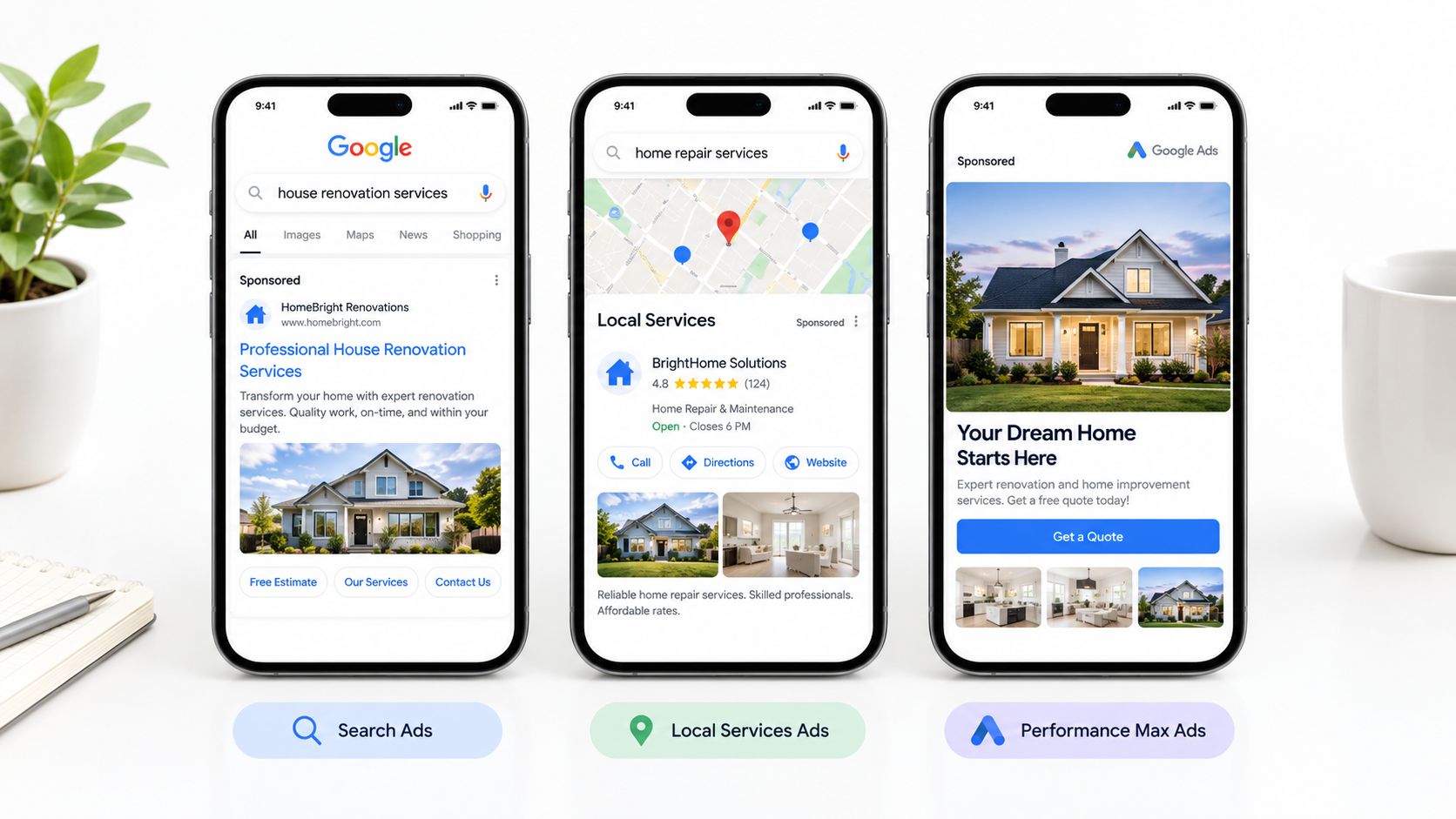
Choose formats by operational readiness
| Format | Practical role | Decision before spending |
|---|---|---|
| Search | Test explicit buyer or seller service intent | Can the agent connect the query to a relevant offer? |
| Local Services Ads | Evaluate an additional local inquiry channel | Are current eligibility, verification, and presentation requirements satisfied? |
| Performance Max | Test a broader automated acquisition approach | Can the team supply useful assets and trustworthy conversion outcomes? |
Local Services Ads deserves its own eligibility and setup review. An agent shouldn't promise a Google Guaranteed badge or assume that every verification label applies to real estate. Current account requirements and the actual ad presentation should govern that decision.
Performance Max requires a different level of restraint. It shouldn't become a way to avoid understanding search intent, and a farm-area awareness objective shouldn't be mistaken for a qualified-lead objective. For a new agent, its broader delivery can make diagnosis harder when the reported conversions don't correspond to workable prospects.
Define budget tiers by scope
Without market-specific campaign evidence, fixed California spending tiers would imply precision that isn't justified. An entry-level budget should fund a focused offer in an area the agent can reliably serve. A growth budget should expand a demonstrated service-and-location combination, while a dominant-market budget requires enough staffing and landing-page coverage to support broader demand.
The benchmark-based spending calculation later in the article provides a planning reference, not a California price guarantee. The guide to evaluating lead-generation services can also help frame whether an additional channel fits the agent's workflow.
Housing-Ad Compliance That Protects Your Campaigns
More granular targeting isn't automatically better targeting. For housing advertising, an agent can create policy risk by applying audience settings that a generic local-business tutorial recommends.
Google restricts ZIP-code targeting, age, gender, parental status, marital status, and certain audience-targeting methods for housing ads serving the United States and Canada, including real estate agent and broker advertising; city, country, and radius targeting remain permitted, and the restrictions depend on where ads serve rather than merely where the advertiser is based (Google's housing-ad targeting policy). A campaign reaching California consumers therefore needs the appropriate review even when its administrator works elsewhere.
Use service relevance instead of demographic proxies
A compliant campaign can still be specific. Neighborhood-intent keywords describe the service being sought, while permitted geography helps align delivery with the agent's actual coverage.
The residential-agent benchmarks discussed earlier don't establish that demographic narrowing improves conversion quality. The more defensible optimization question is whether the query, offer, and service area fit, not whether the advertiser can identify a supposedly ideal household.
Landing pages should describe expertise without suggesting protected-class preferences. Copy about property types, local transaction knowledge, and geographic coverage serves a different purpose from language implying that a neighborhood is suitable only for a particular kind of person.
Audit the complete customer path
The prelaunch review should cover the settings and the experience after the click:
- Geography: Confirm permitted location choices and check whether the selected coverage matches the advertised service.
- Audiences: Review demographic exclusions, customer lists, and visitor audiences against the housing policy rather than copying settings from another industry.
- Ad copy: Remove unsupported claims and language that implies selective service based on protected characteristics.
- Landing pages: Check headlines, imagery, forms, and testimonials for consistency with inclusive service.
- Follow-up: Obtain appropriate consent and avoid assuming permission to contact someone through every available channel.
A narrowly drawn radius isn't automatically a complete compliance solution. The agent should also examine why that boundary was chosen and whether the copy or follow-up process creates a separate concern.
Policy review belongs before launch and whenever someone changes audiences, geography, or creative. A disapproved campaign is inconvenient; a strategy built around impermissible targeting requires more than a quick copy edit.
Landing Pages That Convert Expensive Clicks
A useful seller landing page begins with a service promise such as Pasadena home valuation consultation, followed by a subhead describing the area covered and the assessment process. The dominant action should request that consultation, rather than send the visitor into unrelated listings or a crowded navigation menu.
Trust belongs near the decision point. Use accurate brokerage identification, substantiated credentials, and genuine testimonials when available. If supporting evidence isn't available, clear process information is better than an invented success claim.

Give the visitor a clear next step
Illustrative CTA copy can describe the exchange without promising a sale price or guaranteed result:
Request a local valuation consultation. An agent will review the property details, explain the assessment process, and discuss possible next steps.
The form should collect information that supports routing and preparation. A property location helps establish service fit; an inquiry category distinguishes seller and buyer requests; a timeframe informs the conversation. Contact details and consent support follow-up, but none of those fields alone proves that the prospect is qualified.
A submission should trigger an intake event. Qualification and appointment events should follow actual human outcomes, not just the presence of completed fields.
A designer-ready page brief
- Matched headline: Reflect the keyword cluster and advertised service.
- Local context: Explain the genuine service area without demographic preferences.
- Visible contact action: Make the form or call option easy to find.
- Verified reassurance: Include only supportable credentials and social proof.
- Process explanation: Describe what happens after submission.
- Tested confirmation: Confirm receipt and validate the tracking event.
Otter A/B's landing page conversion rate benchmarks offers a comparison resource, but the agent should assess the page against its own inquiry quality rather than adopt an unrelated target. The practical conversion-rate improvement guide is another resource for refining the experience without confusing form volume with business progress.
Tracking Conversions From Click to Closing Table
A form submission records interest. A connected call records contact. Neither necessarily records a suitable client opportunity.
The stronger measurement approach distinguishes those signals from qualified consultations and client outcomes, with sales-team feedback informing campaign evaluation rather than stopping at cost per form (Skill Mammoth's discussion of real estate lead measurement). The practical challenge is maintaining that distinction consistently across agents and markets.
Build a layered event model
| Measurement layer | Event to record | Purpose |
|---|---|---|
| Initial inquiry | Form submission or tracked call | Confirm that the campaign generated contact |
| Connected conversation | Call answered or substantive response received | Separate reachable prospects from unusable inquiries |
| Qualified appointment | Consultation booked after service-fit review | Identify an actionable opportunity |
| Client outcome | Signed client or completed transaction recorded offline | Connect acquisition with later business results |
For call measurement, the implementation brief should include Google forwarding numbers where supported, test calls, and a defined rule for evaluating meaningful conversations. Call duration alone shouldn't substitute for a service-fit assessment.
Feed human outcomes back into bidding
Primary conversions should represent the outcomes selected to guide bidding; secondary conversions can preserve diagnostic visibility without treating every action as equally valuable. The administrator should confirm the campaign's selected goals and avoid counting the same prospect's intake and appointment as interchangeable successes.
To import consultation-booked outcomes, the CRM needs a dependable connection between the original ad inquiry and the later event. The implementation should preserve supported attribution identifiers, record event timing, and validate the import method against current platform requirements and consent obligations.
Agents should record why inquiries fail qualification, including unsupported service requests, unreachable contacts, and scheduling failures. A brokerage mentor can then distinguish an advertising mismatch from an agent who needs help with consultation handling.
That feedback should improve coaching, not become a crude ranking of agents handling different lead types. Ethical measurement includes whether prospects received accurate expectations and an appropriate handoff.
Smart Bidding, Negative Keywords, and a California Budget You Can Defend
A defensible budget starts with the outcome being purchased. A cheaper inquiry isn't a bargain when it consumes follow-up time without producing a suitable appointment.
Real-estate Search benchmark reports 7.61% average click-through rate, $3.22 average cost per click, 3.70% conversion rate, and $102.51 average cost per lead, compared with $66.69 average cost per lead across industries; at that real-estate lead-cost baseline, 100 conversions imply roughly $10,251 in advertising expenditure before follow-up and transaction costs (WordStream's conversion-rate benchmark summary). That's a planning reference for California agents, not a forecast for a particular city or a promise of qualified appointments.

Match bidding to a trustworthy signal
Maximize conversions is a candidate when the selected conversion represents something the agent wants more of. Feeding it indiscriminate submissions creates a mismatch between the bidding objective and the business objective.
Target CPA should reflect observed performance for that same event and the brokerage's economics. A cost-per-appointment goal can't be borrowed directly from a cost-per-inquiry benchmark, and an aspirationally low target shouldn't replace evidence.
An agent considering manual CPC should weigh the value of direct bid control against the work required to maintain it. Enhanced CPC shouldn't be treated as a permanent launch option; available bidding settings should be checked in the current account rather than copied from an older tutorial.
Govern exclusions and follow-up
Negative keywords need an owner and a review log. The reviewer should examine the search term, explain why it doesn't fit, choose an appropriate exclusion scope, and check that the change won't suppress a valid service request.
Keywordme's how to use negative keywords locally is a useful implementation resource. The agent's exclusions still need to reflect actual services rather than a generic blocklist.
A visitor follow-up plan must also respect the housing policy already described. The team shouldn't deploy website-visitor remarketing audiences by default; permission to contact a prospect doesn't establish permission to use every advertising audience feature. Consent-based email or direct follow-up should have its own documented rules.
Budget discipline: Scale the campaign that produces service-fit appointments, not the campaign that makes the lead report look busiest.
At the monthly review, compare spend with qualified conversations, appointments, client outcomes, and unresolved follow-up. Examine performance by service and region, then investigate weak routing or poor consultation handling before assuming every problem requires a bid change.
A California budget is defensible when the agent can explain what was spent, which opportunities resulted, and what operational capacity supports the next increase. Without that explanation, scaling is a larger experiment.
Ashby and Graff offers California agents broker support, certified mentors, training, and resources covering lead generation and business planning. Agents seeking help connecting advertising decisions with ethical client service can visit Ashby and Graff to explore its brokerage model and discuss the support available for their next stage of growth.