10 Free Real Estate Mentoring Programs for New Agents
A newly licensed agent can spend months learning contracts, lead generation, pricing, and client communication alone. That's frustrating because several structured resources offer guidance at no cost, or include mentoring behind an association or course relationship. The challenge is finding the option that matches the agent's location, background, career stage, and need for transaction support.
This list sorts free real estate mentoring programs by eligibility and cost barrier. It includes nationwide small-business advising, California-specific college pairing, association networks, and a veteran-focused accelerator. Every entry identifies what's free, what may require dues or tuition, what the mentor actually helps with, and where the program falls short. The comparison also shows how outside resources can work alongside broker-provided training and mentorship, including Ashby & Graff's California-focused model.
A new agent shouldn't rely on a community mentor to interpret brokerage forms or approve a high-risk transaction. Those responsibilities belong with the supervising broker and qualified transaction support. Used correctly, outside mentoring can strengthen business planning, prospecting, leadership, and accountability without replacing brokerage oversight.
Agents estimating renovation exposure for clients or investment buyers can also use this rehab cost estimate for agents as part of their property analysis workflow.
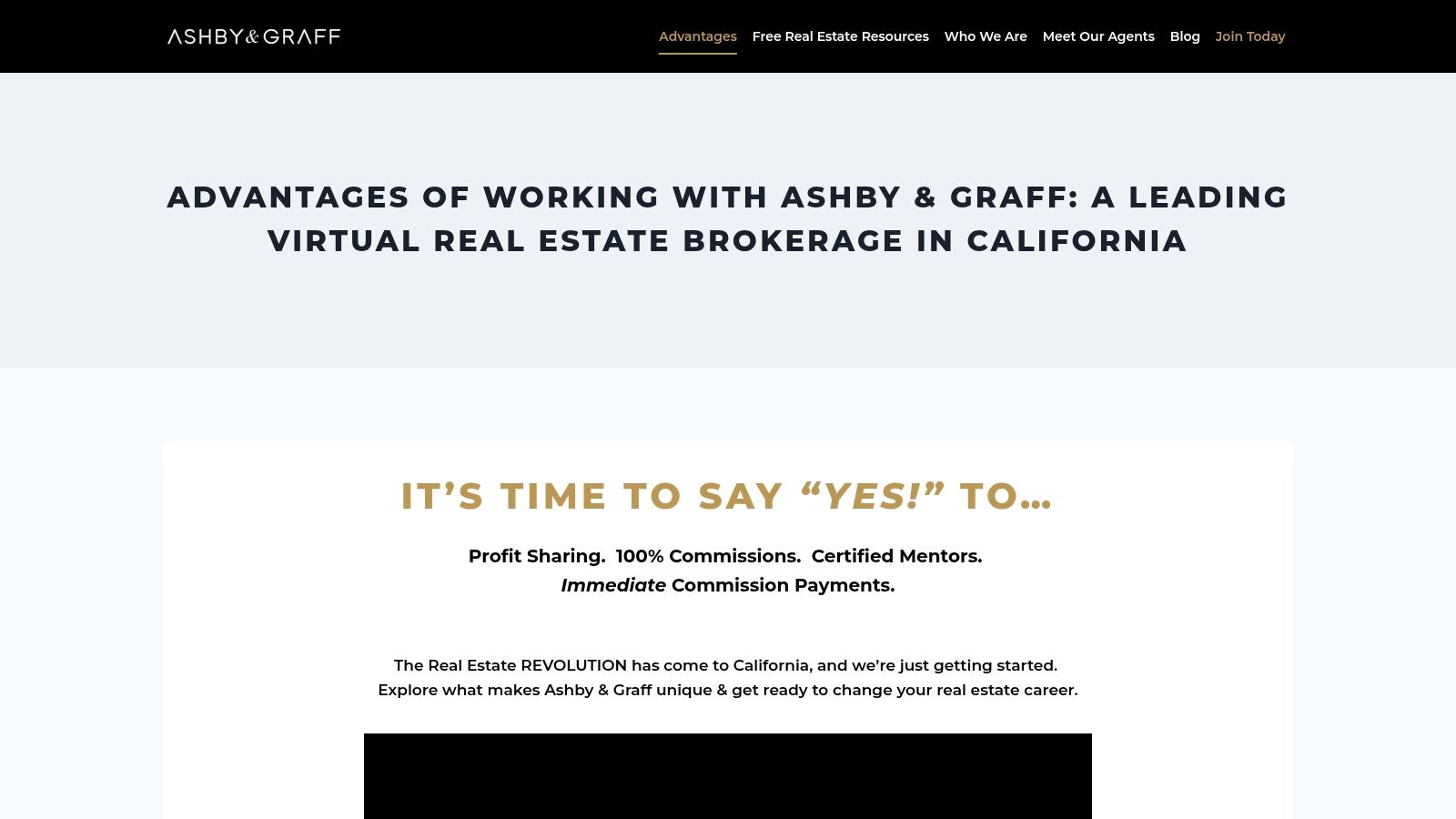
1. Advantages of Working with Ashby & Graff
Ashby & Graff is the strongest fit for a California agent who wants mentorship, training, transaction support, and a brokerage platform in one relationship. The firm pairs agents with certified mentors for practical coaching around lead generation, buyer and seller strategies, negotiation, business planning, and deal execution. That matters because a new license teaches foundational rules, but it doesn't automatically teach an agent how to create pipeline, manage expectations, or move a transaction forward.
The support is designed for active agents rather than passive course consumers. Training and peer assistance are available virtually, by telephone, or in person, and the firm advertises on-demand resources for agents who need help outside a traditional office schedule. Its free back-office and transaction-management resources can also reduce administrative work, leaving more time for prospecting and client service.
Where the model is strongest
The main advantage is integration. A SCORE mentor may help with a business plan, while a local REALTOR® network may provide introductions. Ashby & Graff can connect coaching with brokerage procedures, transaction coordination, lead-generation guidance, negotiation essentials, and business planning.
The firm also advertises 100% commission options with zero broker splits and transparent pricing, along with direct payment at escrow. Agents should review the actual plan terms, fees, and eligibility conditions before joining. A commission model isn't valuable if the agent lacks the discipline to build a pipeline or expects the brokerage to provide fully managed leads.
Practical rule: Ask who reviews an offer, who answers an after-hours transaction question, and what support remains available when a deal becomes difficult.
Ashby & Graff's footprint is focused on Los Angeles, Orange County, San Diego, and the San Francisco Bay Area. That makes it less suitable for an agent outside those markets. It also suits self-directed professionals better than agents seeking a heavily managed sales environment.
Agents comparing the financial side of brokerage mentorship can review this guide to real estate mentorship program cost before weighing commission terms against outside coaching fees.
2. SCORE
SCORE is one of the most accessible choices for an agent who needs business guidance without paying a private coach. The nationwide nonprofit offers confidential, no-cost mentoring for small-business owners, including real estate professionals. Agents can request a mentor through a local chapter or use virtual sessions, then look for experience relevant to real estate, marketing, finance, or operations.
SCORE works best when the problem is business structure rather than transaction mechanics. A mentor can challenge an agent's business plan, review a marketing approach, discuss budgeting, or help define a service niche. The platform also provides free webinars, templates, and courses, so the relationship doesn't have to depend entirely on scheduled conversations.
The useful trade-off
SCORE can support an agent's business from more than one angle. A new licensee might use one mentor for financial planning and another for marketing or operations. That broader bench is helpful when a single real estate mentor isn't strong in every discipline.
The limitation is local brokerage context. A SCORE mentor may understand entrepreneurship but not California disclosure practices, association forms, escrow customs, or a specific broker's compliance process. Those questions should go to the supervising broker.
- Best fit: Agents building a business plan, marketing system, or operating budget.
- Cost barrier: Mentoring is no-cost, with no private coaching fee.
- Main gap: It isn't a transaction-supervision program.
- Smart pairing: Use SCORE for business decisions and the broker for contracts and live deals.
SCORE is also a practical option for experienced agents who want to formalize a team or rethink their business model. It provides an outside perspective without requiring a new agent to give up commission income.
3. America's SBDC and California SBDC
America's Small Business Development Centers provide no-cost, confidential advising and training through a network supported by public and state partners. The service is useful for agents who operate as independent contractors and need to treat their practice like a real business, not just a sales job.
SBDC advisors can help with business plans, marketing funnels, budgets, financial modeling, entity questions, and growth planning. California agents can seek localized assistance through California SBDC centers, which may understand regional business conditions better than a national online community.
What agents can expect
The strongest use case is business infrastructure. An agent preparing to form a team, hire support, establish an entity, or plan expansion can bring those questions to an SBDC advisor. Workshops and webinars can add structure for professionals who need help with operations rather than motivation.
SBDC isn't a substitute for a broker's forms training. An advisor shouldn't be expected to interpret transaction law, approve contract language, or replace a compliance department. Appointment access may also vary by region, so an agent should contact the local center early and explain the specific business need.
A business advisor can improve the operating plan. A broker must remain the transaction authority.
For a new agent, the best sequence is straightforward. Use SBDC to model expenses, define services, and set a prospecting system. Then take the resulting plan to the broker or mentor for market-specific execution.
The program is especially useful for agents who have enough professional independence to make business decisions but lack a reliable framework. It won't create a pipeline by itself. It can, however, expose weak assumptions before an agent invests heavily in technology, advertising, or team overhead.
4. SBA Women's Business Centers
A woman entering real estate may understand sales but still lack a workable business model. The SBA's local assistance network includes Women's Business Centers, which offer no-cost, confidential counseling for women-led businesses. Training may be free or low cost, so each offering requires confirmation.
WBC counseling can help with marketing, capitalization, operations, readiness, and growth. An agent could use that support to set a marketing budget, test a service niche, prepare for expansion, or outline a team structure. Local centers may also provide workshops and connections to market-specific resources.
The fit is strongest before or beyond the transaction file. A new agent building a business can bring questions about expenses, services, and operating priorities to a counselor. A team leader considering support staff can use the same setting to examine costs and readiness.
WBCs do not replace brokerage instruction. They are not the right resource for reviewing listing agreements, disclosures, offers, or compliance decisions. Those issues belong with the supervising broker, brokerage trainer, or compliance team. Some classes and workshops also charge a fee, even when individual counseling costs nothing.
- Useful for: Women founders who need business planning and operational guidance.
- Free component: Confidential one-to-one counseling is available at no cost.
- Possible expense: Some classes and workshops are low cost rather than free.
- Weak fit: Agents seeking live contract review or transaction supervision.
The network can give agents without established industry contacts a practical starting point. It may suit someone who needs a focused business conversation rather than a large library of content. Pair that support with broker-provided training, including programs such as Ashby & Graff's, because WBC advice improves the business side while brokerage mentorship handles transaction execution.
5. NAREB Young Realtist Division Mentorship
The National Association of Real Estate Brokers and its Young Realtist Division offer mentorship, leadership development, peer support, and business programming for Black real estate professionals. The value is not limited to sales technique. Local chapters can expose newer agents to advocacy, leadership pathways, community relationships, and experienced practitioners who understand the importance of representation in housing.
YRD is a strong option for an agent who wants culturally specific support rather than a generic online coaching relationship. Local chapter activity may include formal and informal mentoring, networking, professional development, and opportunities to work alongside rising and established professionals.
Eligibility and cost
The main cost barrier is membership. Mentoring opportunities are generally connected to NAREB or local chapter participation, and dues vary by chapter. That means the program isn't universally free in the strict sense, even when a specific mentoring activity carries no separate charge.
Program structure can also differ between chapters. One local group may offer a regular pairing process, while another may rely more heavily on events and informal introductions. Applicants should ask how mentors are selected, how often participants meet, and whether the relationship includes transaction-related guidance or focuses on leadership and networking.
A new agent seeking local referrals may find the chapter environment more valuable than a remote mentoring platform. An agent who needs consistent offer review, disclosure guidance, or immediate broker access should still treat NAREB as an additional network rather than the transaction backbone.
6. CREW Network Local Chapter Mentorship
CREW San Diego illustrates how a local CREW chapter can provide mentorship through a program such as CREWmates. CREW is built around women in commercial real estate, and local chapters often connect early-career professionals with experienced practitioners across brokerage, development, finance, and asset management.
This option makes sense for an agent moving toward commercial real estate, mixed-use work, investment sales, or development relationships. The cross-disciplinary exposure can help a residential agent understand how other professionals evaluate deals, structure projects, and build long-term careers.
Why residential agents may outgrow the fit
CREW mentorship is not a general new-agent program. A purely residential agent who needs help with open houses, buyer consultations, listing presentations, or residential contracts may find the subject matter too distant from daily work. The program is better suited to someone who has a clear interest in commercial practice.
Participation is usually application-based and tied to paid chapter membership. Spots may be limited, so eligibility and timing need to be confirmed with the relevant chapter. The financial barrier isn't always a separate mentoring fee. It may be the cost of membership and the time required to participate consistently.
Commercial mentoring is valuable only when the agent's target business is commercial. A prestigious network won't fix a mismatch between the mentor's expertise and the agent's market.
For the right participant, the benefit is access to senior dealmakers and a broader view of the industry. For a new residential licensee, broker-led training or a local residential association network will usually solve more immediate problems.
7. NAR Young Professionals Network
A new agent who wants local relationships, committee experience, and practical visibility may find the NAR Young Professionals Network useful. YPN connects newer and rising REALTORS® through local and state committees, but it is not one uniform national mentor-match program. Each local board decides whether to offer events, peer mentoring, leadership development, or professional education.
The local committee determines the actual value. An active group can introduce an agent to producing REALTORS®, association leaders, and referral partners. Regular attendance may lead to informal mentoring through conversations, committee work, and follow-up. A less active committee may provide little beyond occasional social events.
Before joining, ask the local board four direct questions:
- Mentor matching: Are there formal pairings, mentor circles, or only networking events?
- Participation rules: Can every member participate, or is an application required?
- Local access: Are meetings virtual, in person, or both?
- Business value: Do sessions cover referrals, leadership, and skills, or mainly social activities?
YPN usually sits behind a REALTOR® association membership and its related dues. Those dues buy access to the network, not a guaranteed mentoring service. Confirm the current requirements and schedule with the local board.
This option suits agents who learn through discussion and repeated contact. It is a weak fit for anyone needing a fixed curriculum, guaranteed response times, or a mentor assigned to each transaction. Broker-provided training, including support such as Ashby & Graff's, is more direct for transaction-specific questions. YPN works best as a local relationship channel when the agent arrives prepared, follows up, and contributes consistently.
8. Women's Council of REALTORS
The Women's Council of REALTORS is a national REALTOR® network focused on leadership, business development, and mentorship for women in real estate. State and local chapters may offer leadership institutes, mentoring initiatives, networking, and member-driven development programs.
WCR suits an agent who wants to build influence and business judgment over time. Its programming can support team building, strategic thinking, communication, and leadership. Those skills matter for agents who plan to become team leaders, managers, association volunteers, or local market authorities.
Not a replacement for deal coaching
WCR generally requires paid membership, and local programming varies. Some opportunities may be included with membership, while others may require separate registration or participation in a chapter program. Agents should verify the current terms directly with the local or state organization.
The network's main limitation is focus. It tends to develop leadership and business capability rather than teach every transaction mechanic. An agent who needs immediate assistance with disclosures, inspection negotiations, or offer strategy should use brokerage support for those needs.
WCR works particularly well as a long-term professional network. A newer agent can gain access to experienced women in the field, learn how they manage client relationships, and develop leadership habits that aren't covered in pre-licensing education. It may be less useful for an agent who wants a short, tightly scripted onboarding course.
9. Sacramento Association of REALTORS and Los Rios Community College
The Sacramento Association of REALTORS partnership with Los Rios Community College offers a California-specific path that combines coursework, internship exposure, and mentorship. The Sacramento Association of REALTORS has highlighted a model in which students in a for-credit real estate course pair with practicing REALTORS® and gain exposure to daily agent work.
The structure is more concrete than informal networking. Students can observe professional routines, learn how agents handle transactions, and connect classroom concepts with actual practice. The California Department of Real Estate has also highlighted the partnership, which gives the program credibility for students exploring a California real estate pathway.
The access limitation matters
This isn't a nationwide free mentoring program. Access is primarily tied to the Sacramento and Los Rios community college environment, and mentorship comes as part of tuition-bearing coursework. The program may satisfy certain California DRE education pathways, but prospective students should verify current requirements directly with the college and regulator.
The strongest candidate is a California student who wants an organized bridge from education into practical exposure. An already licensed agent outside the Sacramento area won't receive the same access.
The difference between this model and a casual mentor relationship is accountability. The student has a course structure, an educational objective, and an internship connection. Agents evaluating other programs should look for those same features rather than accepting a directory listing or occasional webinar as equivalent support.
Agents comparing structured brokerage mentorship with college-based exposure can also review this real estate mentorship program from Ashby & Graff for a California brokerage alternative.
10. Bunker Labs and Military Founders Lab
A veteran agent building a real estate company, investment business, or service platform may need business guidance that a transaction mentor does not provide. The IVMF Military Founders Lab, formerly associated with Bunker Labs and Veterans in Residence, offers military-connected entrepreneurs free, no-equity cohort support, mentorship, peer accountability, and business-building resources.
The program addresses customer acquisition, growth strategy, positioning, and access to capital. Its founder community can also help an agent test ideas with people facing similar business pressures. That focus suits an entrepreneur building beyond individual sales.
Eligibility determines the fit
Applicants must be military-connected entrepreneurs, such as veterans and qualifying spouses or other connected participants. The program does not teach residential contract mechanics or replace broker supervision. It develops the business around the transactions, rather than directing live deal execution.
The cohort is free and does not require participants to give up ownership. Applicants should still confirm current cohort requirements, timing, and the application process before committing.
- Best fit: Veteran or military-connected agents building a business beyond individual sales.
- Cost barrier: Free participation with no equity requirement.
- Primary benefit: Business strategy, peer support, and founder accountability.
- Main gap: Little instruction on brokerage forms, disclosures, or live transactions.
For an eligible agent, the strongest use is alongside brokerage mentorship. A broker can address compliance, contracts, and transaction risk, while the Military Founders Lab helps strengthen customer acquisition and the wider business model. An agent without military ties should choose a nationwide program or a local association network instead, since this program's eligibility limits access.
Comparison of 10 Free Real Estate Mentoring Programs
| Program | Core features | Target audience | Key benefits / Value proposition | Limitations | Cost |
|---|---|---|---|---|---|
| Advantages of Working with Ashby & Graff | Certified mentors, 24/7 training, free back-office & transaction coordination, true 100% commission options, premium CA brand | New & experienced agents in LA, OC, SD, Bay Area seeking autonomy + support | Keep more commission, mentor-driven deal acceleration, faster escrow payouts, streamlined admin | California-focused, requires self-driven lead generation | 100% commission options; transparent fees |
| SCORE | Nationwide 1:1 mentoring, mentor matching by ZIP, webinars & templates | Small-business owners & real estate pros nationwide | Truly free ongoing mentoring, flexible formats, large resource library | Not real-estate-only, mentor quality varies by chapter | Free |
| America's SBDC (incl. CA SBDC) | Free 1:1 advising, workshops, state/local hubs, financing & planning help | Agents building solo practices or teams; those needing finance/planning | Local market and financing guidance, help with business structure and growth | Not transaction/contract specific; availability varies by region | Free |
| SBA Women's Business Centers (WBCs) | No‑cost counseling, low‑cost training, women‑focused resources, local centers | Women REALTORS and women-led real estate businesses | Tailored support for capitalization, marketing, operations; scaling readiness | Not transaction-specific; some workshops may charge fees | Mostly free / low-cost |
| NAREB – Young Realtist Division (YRD) Mentorship | Formal/informal mentoring, leadership development, local chapters | Black real estate professionals and emerging agents | Culturally specific support, networking, advocacy & leadership pathways | Often requires paid membership; chapter consistency varies | Membership dues vary |
| CREW Network (local chapters) | Chapter mentorship cohorts, cross-disciplinary CRE exposure, senior mentors | Women in commercial real estate or agents moving into CRE | Access to senior CRE dealmakers, career acceleration in CRE | Paid chapter membership, program spots limited, CRE-focused | Membership / program fees (varies) |
| NAR Young Professionals Network (YPN) | Local mentor circles, pairing, leadership & peer networking | Young REALTORS and early-career agents | Warm introductions to high-producing peers, visibility & referrals | Benefits vary by local board; REALTOR dues usually required | REALTOR association dues apply |
| Women's Council of REALTORS (WCR) | Leadership Institute, chapter mentorship, member grants | Women REALTORS seeking leadership & business growth | Strong mentorship culture, tangible business & leadership skills | Paid membership; less focus on transaction mechanics | Membership fees |
| Sacramento Assoc. of REALTORS x Los Rios (internship) | For-credit mentorship, job shadowing, transaction exposure, DRE-recognized | Students and early-career agents in Sacramento / Los Rios | Structured, course-embedded mentorship with real-world experience & DRE alignment | Geographically & enrollment limited; tied to coursework/tuition | Course tuition (mentorship included) |
| Bunker Labs / Military Founders Lab (IVMF) | Free cohort programs, mentorship, mastermind peer networks, national/local hubs | Military-connected entrepreneurs (veterans, spouses) | High-engagement mentor/peer ecosystem, investor network, no equity required | Limited to military-connected participants; business vs. transaction focus | Free, no equity |
Build a Free Mentoring Mix Before Your First Listing
A single mentor rarely covers every problem facing a new agent. Business planning, local referrals, leadership, prospecting, negotiation, contract compliance, and transaction management require different kinds of expertise. The strongest approach is a free mentoring mix with clear boundaries between each resource.
Start with one nationwide or state resource for business planning. SCORE can help with marketing, finance, and operations, while SBDC can provide localized advising for a solo practice or growing team. Women's Business Centers offer a focused option for women-led businesses, and Military Founders Lab serves eligible veteran and military-connected entrepreneurs.
Add one association or professional network for local relationships. NAR YPN, NAREB YRD, WCR, and CREW can provide introductions and peer support, but their access often depends on membership, chapter activity, or a defined professional identity. A network is useful only when the agent participates consistently and follows up with the people met through it.
The broker's training should remain the transaction backbone. External mentors may offer sound business advice but still lack authority over the agent's forms, disclosures, escrow procedures, and compliance obligations. The National Association of REALTORS®-referenced early-career survey found that nearly 60% of agents reported having a mentor at the beginning of their careers. Among new agents completing at least seven transactions in a year, 68% reported having a mentor. The association also reported that more than 60% of agents who stayed in the profession beyond the commonly discussed five-year tipping point had access to a mentor. Those findings are observational, so they show association rather than proof that mentoring alone causes success.
Training gaps deserve attention. More than half of new agents reported insufficient overall training, while almost 70% wanted more instruction on obtaining seller prospects, according to the same NAR-referenced survey. A useful program should therefore cover prospecting, online advertising, social media, negotiation, transaction execution, and ethical client service, not just licensing theory.
The cost question also needs a closer look. A Consumer Federation of America review found that major firms commonly offered training, while formal mentorship was less common and often organized by individual offices. One reviewed model required inexperienced agents to complete mentoring through their first three transactions, but mentees paid 20% of brokerage fees on those mentored transactions. That distinction matters. “Free training” and “free mentoring” aren't interchangeable, and commission conditions can create a real cost even when tuition is zero.
Program quality should be measured through behavior, not enthusiasm alone. A 2025 Canadian workplace mentorship survey found that mentored employees most often reported benefits in skill acquisition and handling difficult workplace situations, both at 89%, career advancement at 83%, and job satisfaction at 90%. Those figures are cross-industry benchmarks, not evidence of real estate production gains. A brokerage can still borrow the measurement discipline by tracking competencies such as transaction-platform use, lead conversion, contract-risk escalation, negotiation practice, and business planning.
A longitudinal mentoring pilot also offers a useful survey benchmark. It reported that 93% of eligible participants completed the pre-program survey, while 70% completed all three surveys. The share rating satisfaction as excellent rose from 21% before participation to 50% afterward. The pilot was small and isn't a market average, but it demonstrates why programs should track attendance, mentor-match acceptance, participant sentiment, and behavioral outputs at multiple checkpoints.
Before joining, the agent should ask practical questions:
- Transaction access: Will the mentor review an offer before submission, attend a listing appointment, or help with inspection negotiations?
- Availability: What response time can the agent expect during an active deal?
- Qualifications: How recent and relevant is the mentor's production or brokerage experience?
- Accountability: Are there scheduled meetings, written goals, and follow-up reviews?
- True cost: Are there dues, production requirements, commission conditions, technology expenses, or mandatory fees?
- Market fit: Does the mentor understand the agent's city, client segment, and property type?
New agents also need a financial and access audit. Mentorship can improve readiness, but it can't eliminate delayed income, unpaid prospecting time, startup expenses, taxes, insurance, MLS and association dues, technology costs, or market-cycle risk. NAR firm data describes widespread independent-contractor structures, which makes first-year operating assumptions especially important for agents choosing a brokerage model.
The final choice should match the agent's situation. SCORE or SBDC may be weak for live contracts but excellent for business planning. YPN may open local doors but lack a standardized mentor match. CREW may be powerful for commercial ambitions and irrelevant for a residential starter. A college pairing may offer structured exposure but remain geographically and enrollment limited. Ashby & Graff may suit California agents who want certified mentoring, training, back-office support, and a commission structure in the same brokerage relationship. Those terms should be compared directly with the Ashby & Graff brokerage option, including the agent's expected level of self-directed business development.
Set a review point after the first 90 days. The agent should evaluate whether the mentor is improving response habits, prospecting consistency, appointment preparation, negotiation confidence, transaction execution, and business planning. If the program produces only inspirational conversations, it isn't meeting the need.
Ashby & Graff offers California agents certified mentorship, practical training, free back-office and transaction resources, and commission plans with zero broker splits and transparent terms. Agents who want brokerage support alongside free real estate mentoring programs should review the firm's model and Ashby and Graff before choosing a mentor mix.