
Real Estate Lead Generation Pay at Closing: Key Tips
The agent is sitting in the car after an open house, phone face down on the passenger seat, looking at another lead invoice and wondering whether paying for pipeline every month still makes sense. That moment usually comes after a few weak internet leads, a couple of no-shows, and the realization that the bill is due whether anyone closes or not.
That's where real estate lead generation pay at closing starts to look attractive. It feels simpler because the money doesn't leave the business upfront. The catch is that the bill hasn't disappeared. It has just moved to escrow.
What Pay-at-Closing Lead Generation Actually Means for Agents
At the practical level, pay-at-closing means the lead source gets paid only if the transaction closes. Instead of charging per lead or charging a monthly subscription, the provider sends an agent a buyer or seller opportunity and takes an agreed referral fee from the commission at the end of the deal.
For a mid-career California agent, that changes the conversation from “How much should be spent this month?” to “How much of the back end is worth giving up for lower front-end risk?” That's the trade.
What the model shifts
The defining feature is risk transfer. In a traditional lead subscription, the agent carries the cost whether the lead responds, ghosts, rents, or buys with someone else. In a pay-at-closing arrangement, the provider carries the acquisition cost until a closing happens.
That structure matters because the fee is tied to the success event, not the inquiry. Industry reporting describes these programs as broker-to-broker referral arrangements where the agent pays nothing upfront and owes the fee only if the deal closes, commonly in the 25% to 40% of gross commission range, with many programs clustering around 30% to 35% according to Real Estate Skills on pay-at-closing lead models.
Practical rule: Pay-at-closing isn't cheaper. It's delayed and variable.
Why agents consider it
This model often appeals to agents who are tired of funding experiments. A monthly portal spend or lead package can feel manageable at first, then turn into a fixed overhead line that keeps draining margin. Pay-at-closing removes that immediate pressure and lets the provider bet on conversion.
It also pairs well with systems that reduce manual follow-up drag. Agents reviewing options like lead generation autopilot are usually trying to solve the same core problem from a different angle: how to create consistent lead flow without stacking more fragile monthly commitments.
Still, nobody should confuse this with generosity. The provider has already priced in fallout, slow nurture, and closed-deal probability. If an agent closes well, the provider gets paid very well. If the agent closes poorly, the provider gets nothing and adjusts routing accordingly.
How the Referral Pipeline Works From Inquiry to Escrow
Most agents hear “pay at close” and think about marketing. The cleaner way to understand it is as an escrow workflow with a lead attached.
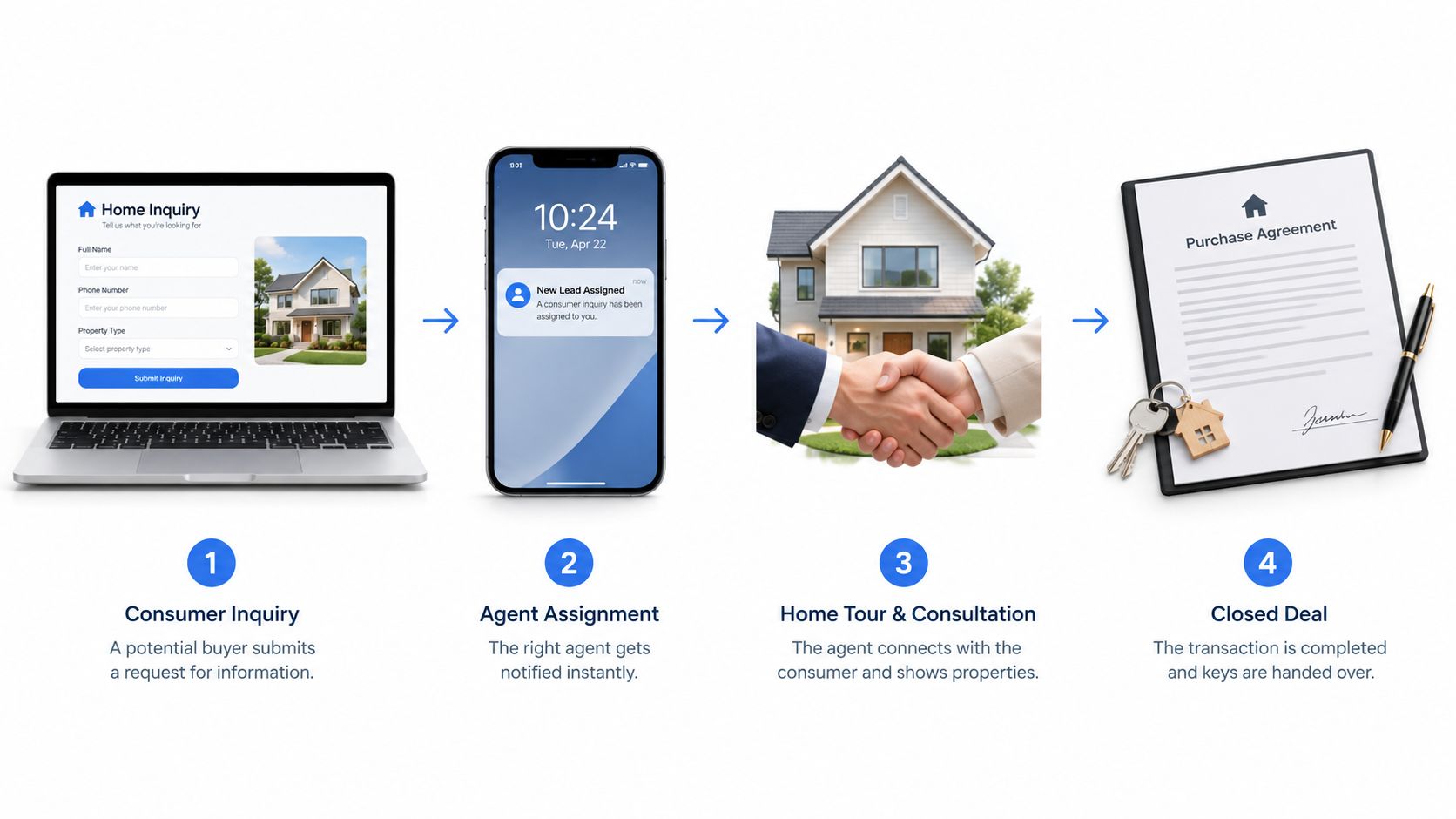
Step one through step three
A consumer raises a hand.
The inquiry usually starts on a portal, landing page, ad form, or phone line controlled by the provider.The provider screens and routes it.
Some providers do light qualification. Others mainly confirm the lead is reachable, then push it out by CRM alert, email, text, or live transfer. Operationally, these programs often depend on pre-screening, routing, and follow-up rules, with access to future referrals tied to compliance, as described by Real Geeks in its discussion of pay-at-closing operations.The brokers paper the referral.
Before the deal gets far, there's usually a referral fee agreement between the originating broker and the receiving broker. In the broader market, referral fees have long clustered around 25% of the gross commission, with many summaries describing 20% to 35% as typical and 10% to 50% as a broader observed span. Inman's summary of a 2017 survey also reported that roughly two-thirds of respondents said they received a fee when an outbound referral led to a closed sale, and about three-quarters expected 25% of the total commission for outbound referrals. More than half preferred to pay about 25%, while over a third were willing to pay 30% to 35% according to Inman's referral survey coverage.
Where the work really happens
After routing, the agent does the same work required for any other client. Calls. Texts. Property tours. Listing prep. Negotiation. Inspection drama. Lender coordination. Appraisal management. The lead source doesn't remove agency work. It removes the need to source that opportunity upfront.
What trips agents up is the control layer. The provider often sets response expectations, reassignment triggers, and reporting rules. If the lead goes cold, some programs keep it assigned; others may recycle or dispute ownership depending on the contract.
If the provider controls routing and follow-up, speed stops being a nice habit and becomes a revenue requirement.
What happens at closing
At escrow, the gross commission is paid to the broker of record. The referral fee is then deducted and sent to the referring broker according to the signed agreement and closing instructions. The remainder flows through the receiving side's normal split and disbursement process.
If the client closes with another agent, the contract controls whether the fee is still owed. If the consumer never transacts, there's usually no referral payment. That's the attraction. The risk stays dormant until money lands.
Comparing Pay-at-Closing, Pay-Per-Lead, and Subscription Models
Agents usually compare these models emotionally first. One feels safer. Another feels more controllable. A third feels more scalable. The better comparison is operational: cash exposure, control, and where margin gets shaved.
What changes from model to model
Pay-at-closing pushes acquisition cost to the end of the transaction. Pay-per-lead charges for contacts whether they convert or not. Monthly subscription wraps tools, visibility, or lead flow into a recurring fixed cost.
That difference affects behavior. Agents paying upfront tend to become highly selective about speed-to-lead, nurture systems, and database discipline because they're trying to recover sunk cost. Agents using pay-at-closing often accept lower control in exchange for lower immediate cash pressure.
Pay-at-Closing vs Pay-Per-Lead vs Subscription
| Dimension | Pay-at-Closing | Pay-Per-Lead | Monthly Subscription |
|---|---|---|---|
| Upfront cash exposure | Low. No payment until closing | Immediate. Payment starts when leads are delivered | Immediate and recurring |
| Risk distribution | Provider carries early acquisition risk | Agent carries contact-level risk | Agent carries platform or channel risk |
| Control over pipeline | Lower if the vendor controls routing and rules | Moderate, depending on source and CRM access | Usually higher than referral programs, but varies by vendor |
| Lead ownership | Often limited or shared by contract | Depends on vendor terms | Often stronger if leads live in the agent's CRM |
| Commission impact | Reduces the back-end commission by referral fee | No direct commission slice | No direct commission slice |
| Ease of pausing | Contract dependent | Usually easier than referral agreements | Usually tied to billing cycle or term |
| Best fit | Agents protecting cash flow | Agents who can work volume and track conversion tightly | Agents building repeatable systems |
For agents weighing programs side by side, it helps to review examples of how firms package these choices in real estate lead generation programs.
What usually works and what usually doesn't
Pay-at-closing works best when an agent has strong conversion habits but doesn't want to pre-fund a large pipeline. It also helps when the lead source sends consumers who are already fairly close to action.
Pay-per-lead works better when the agent wants more control over speed, scripting, and long-tail nurture. Subscription models make more sense when the agent is building an owned database and wants continuity, even during slow months.
What doesn't work is mixing models without tracking source quality. If every lead source gets the same follow-up and no one measures actual closings, a team ends up arguing from anecdotes instead of numbers.
ROI Reality Check: When the Math Breaks Down
An agent closes a $900,000 deal in California, sees a healthy gross commission on the settlement statement, and assumes the lead source was worth it. Then the deductions stack up. Referral fee, broker split if there is one, transaction coordination, team split, marketing reimbursements, and taxes. What looked fine at contract acceptance can feel thin by the time escrow disburses.
That is the right way to judge pay-at-closing. Start at the closing table, not at the lead handoff.
Why the model can still pencil out
Pay-at-closing protects cash flow. If leads do not convert, the agent is not writing checks every month to keep the pipeline alive. For agents at a zero-split brokerage, that can be especially attractive because the referral fee may be the biggest variable deduction on the file, and it is visible immediately on the closing statement.
That trade can make sense. Recent 2026 lead-generation data placed the blended industry average cost per lead at about $448, while estimated cost per closed deal varied sharply by channel, from roughly $625 to $1,500 for expired listings to $2,500 to $8,000+ for Zillow Premier Agent, according to DealMachine's 2026 lead-generation statistics. Those numbers do not prove pay-at-closing wins. They do explain why many agents would rather give up part of the commission at disbursement than absorb acquisition cost upfront with no closing attached.
The catch is simple. A deferred cost still has to be affordable.
ROI comparison by how the money leaves your file
| Metric | Pay-at-Closing (25% referral) | Pay-Per-Lead ($40/lead) | Subscription ($300/mo) |
|---|---|---|---|
| Upfront spend | None until closing | Ongoing as leads arrive | Ongoing monthly |
| Cost structure | Variable and tied to a funded closing | Variable but paid before outcome | Fixed recurring cost |
| Cash-flow pressure | Lower before escrow closes, higher at disbursement | Steady during lead intake | Steady whether deals close or not |
| Commission effect | Direct reduction to gross commission on the closed file | No direct commission slice | No direct commission slice |
| Best-case fit | Agent wants lower front-end risk and can absorb the back-end fee | Agent converts at high volume and tracks source quality tightly | Agent has a repeatable nurture system and wants to build owned pipeline |
| Where it breaks | Thin deal, stacked deductions, weak lead quality, or poor territory fit | High junk-lead volume | Monthly spend outruns actual pipeline discipline |
A pay-at-closing lead can produce a closing and still miss the margin target once the escrow officer pays out every party tied to that transaction.
Where the math usually fails
The first failure point is a small net commission. In California, that often means one side of the deal was already under pressure before the referral fee hit. Maybe the property price was lower than your farm average. Maybe a listing concession grew during inspections. Maybe you paid a buyer broker concession on a listing that took more work than expected. Add a 30% to 40% referral fee and the remaining commission may not support the hours, mileage, brokerage costs, and tax reserve tied to that file.
The second failure point is stacked splits. Agents sometimes compare a pay-at-closing fee to a pay-per-lead invoice and stop there. That misses how the money is taken. If the referral company is paid through escrow, the deduction comes right off the top of the commission due on that transaction. If the brokerage also has a split, franchise fee, or desk fee recovery, the order of deductions matters. At a zero-split shop, pay-at-closing may still work well because there is no second major haircut behind it. At a traditional split brokerage, the same referral percentage can feel much heavier.
Lead quality is the third failure point. Independent reporting in 2024 noted that only about 5% of sellers and 4% of buyers found their agent through another agent's referral, while consumer advocacy research has argued that referral companies commonly charge agents 30% to 40% of earnings at closing, according to HousingWire's reporting on referral fees. That is a reminder to treat these programs as one channel, not the whole business, and to judge them by closed-file economics, not by lead count.
One more practical issue gets missed. A provider can send a legitimate lead and still be a poor fit if the inquiry is stale, outside your core geography, or subject to a dispute process that drags on after closing. If the contract leaves room to argue about procuring cause, reactivated leads, or whether a past client overlap triggers a fee, the ROI gets worse fast because the cost is no longer just the referral percentage. It is also the time spent defending the file.
Evaluating Providers With a Practical Vetting Checklist
A discovery call with a pay-at-closing provider should sound less like a sales demo and more like an operations interview. The provider is asking an agent to give up margin and some control. That earns scrutiny.

Questions that matter before signing
- Routing logic: Ask who decides which agent gets the lead, whether the same inquiry can touch multiple agents, and whether geographic exclusivity exists in writing.
- Lead recency: Ask how old a lead can be when it's delivered. “Fresh” means different things to different vendors.
- Follow-up requirements: Ask how quickly the first call, text, or email must happen, and what documentation proves compliance.
- Lead ownership after nurture: Ask whether the contact stays in the agent's CRM if the relationship takes months to mature.
- Escrow failure rules: Ask what happens if a transaction cancels, relists, changes entity names, or closes after a long pause.
Contract traps that deserve slow reading
Some agreements look simple until the definitions section. That's where hidden exposure usually sits.
- Auto-renewal language: Terms that continue unless canceled during a narrow window.
- Broad tail periods: Clauses that require payment long after the initial introduction.
- Chargeback language: Provisions that try to reclaim fees or impose liability after a failed disbursement.
- Non-compete radius restrictions: Limits on where an agent may work similar lead sources.
- Ambiguous “closed transaction” wording: Loose drafting around lease deals, off-market sales, or entity transfers.
A useful companion resource for thinking through how referral systems are structured is this practical referral launch playbook, especially for agents who want to compare provider terms against a more process-driven referral setup.
Check this in writing: If the lead talks to the agent, disappears, and reappears months later through another path, the agreement should clearly say who gets paid and why.
Three recent California references matter more than a polished sales deck. So does checking whether the provider's disclosure process aligns with the broker's policy manual and transaction workflow.
Legal and Ethical Considerations Agents Often Miss
A lot of referral arrangements are discussed as if they're just business-development choices. They're not. They sit inside a regulated transaction environment, and that changes the standard.
The fee itself is not the only issue
Broker-to-broker referral payments are common. The problem starts when someone gets casual about who is paying whom, what was disclosed, and whether the arrangement drifts into prohibited territory involving settlement services or undisclosed compensation.
California agents also have to think beyond the lead source's intake form. Co-branded pages, online ad copy, text consent language, and brokerage identification all matter. If the provider's landing page is sloppy, the agent can still inherit risk when the consumer later claims confusion about agency, advertising, or compensation.
Practical compliance checks
- Broker review first: Referral agreements should run through the broker, not just the agent.
- Clear closing-file documentation: The payment path should be traceable in the transaction file and reflected in disbursement instructions.
- Advertising identity: Any co-branded consumer page should make it clear who the consumer is dealing with.
- No side deals: The fee belongs in the authorized broker-to-broker framework, not in informal back-channel promises.
- Consumer clarity: If the consumer would reasonably care that compensation is being shared, the file should reflect the brokerage's disclosure practice.
The agent doesn't outsource fiduciary exposure to the lead company. If disclosures are weak, the complaint still lands on the licensee and broker file.
The practical point is simple. A provider may generate the opportunity, but the receiving side still owns the duty to keep the transaction compliant from intake through closing.
Why Pay-at-Closing Fits California Brokerage Structures
The conversation gets real for California agents. The value of pay-at-closing isn't just “no upfront cost.” It's that the fee can be handled inside the existing escrow and commission disbursement flow instead of becoming one more monthly expense outside the transaction.
Why the structure matches California operations
In California, many agents already think in terms of gross commission in, brokerage review, deductions, and final disbursement out. That makes referral-style lead models easier to evaluate than abstract marketing bundles.
The fee flow is especially straightforward in a zero-split or flat-fee environment. The commission comes into the broker of record through escrow. The referral fee is paid out per the agreement. The remaining funds are disbursed according to the brokerage model. There's no separate reimbursement chase if the transaction file is set up correctly from the start.
Pay-at-Closing Fee Flow Inside a California Zero-Split Brokerage
| Line Item | Amount | Recipient | Notes |
|---|---|---|---|
| Gross commission received at closing | Qualitative | Broker of record | Paid through escrow per closing statement |
| Referral fee deduction | Typically in the common market range already discussed | Referring broker | Paid according to signed referral agreement |
| Brokerage fee or flat transaction charge | Depends on brokerage model | Receiving brokerage | Reviewed against brokerage policy |
| Net commission balance | Remainder after authorized deductions | Agent or agent entity | Disbursed per brokerage and tax setup |
That operational fit is one reason the model can be cleaner than carrying recurring lead invoices. For a California agent on a high-retention split plan or zero-split plan, the question isn't “Can this be paid?” It's “Does this referral fee leave enough commission after all other deductions to justify the work?”
Where this especially helps
Agents with strong local conversion skills but uneven monthly cash flow often prefer a cost structure tied to closings. The same is true for specialists serving bilingual communities, rural pockets, or niche price bands where lead volume may be lower but intent is stronger.
This is also the one place where a brokerage's mechanics matter more than its branding. A firm with direct payment at escrow and clear transaction accounting can make these referrals easier to absorb. Some California models, including Ashby & Graff's flexible commission structures and direct-payment workflow, are built around that kind of escrow-first disbursement logic rather than around back-end reimbursement.
Building a Lead Mix That Makes Pay-at-Closing Worth It
Pay-at-closing rarely performs best as a stand-alone strategy. It works better as one lane in a lead mix, alongside channels the agent owns more directly.
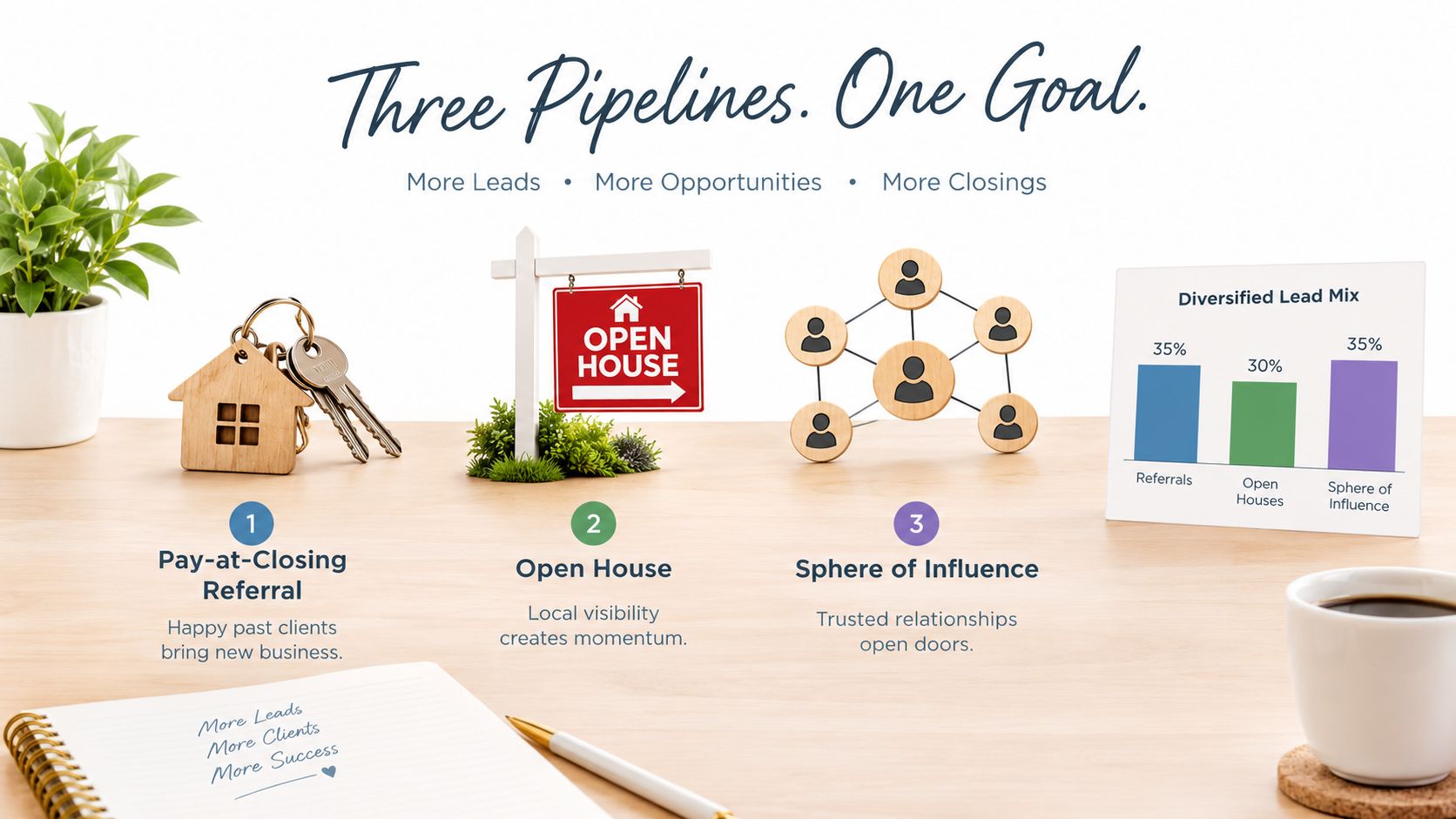
A healthier way to use the model
A balanced pipeline usually combines:
- Self-sourced business: Sphere, open houses, repeat clients, local relationships.
- An owned or semi-owned nurture channel: Website leads, CRM reactivation, farming responses.
- A managed volume source: Subscription or platform visibility where lead flow is more consistent.
- A pay-at-closing lane: Used for referral-style opportunities where the handoff quality justifies the commission cut.
That's the difference between using pay-at-closing as a tool and using it as a crutch.
Decision rules that keep the channel honest
An agent should keep this channel only when several things remain true at the same time:
- The average deal supports the fee. If the remaining commission doesn't cover time, brokerage costs, and taxes, the deal count can rise while real profit falls.
- The provider's process is tight. Slow routing, weak screening, and murky ownership terms ruin the logic.
- The brokerage can tolerate delayed cash flow. Payment comes at closing, not at lead delivery.
- Quarterly review is real. If the source consumes too much time for too little net, it needs to be reduced or cut.
Agents refining response systems can also borrow ideas from adjacent industries. This article on converting home service leads faster is useful because the discipline is similar: speed, qualification, handoff, and consistent follow-up usually beat clever branding.
For a broader approach to owned pipeline, this guide to real estate lead generation strategies helps frame where referral-based leads should sit relative to sphere, open houses, and nurture channels.
Good lead mix decisions are usually subtraction decisions. If a provider adds activity but weakens net commission quality, the pipeline looks busier while the business gets thinner.
The agents who make this model work don't treat every closed side as a win. They judge each source by how it fits inside escrow, commission retention, follow-up burden, and repeat-business potential. That's the level where real estate lead generation pay at closing either becomes useful or starts eating the business from the back end.
Ashby & Graff offers California agents flexible commission structures, zero broker split options, and direct payment at escrow, which makes pay-at-closing lead models easier to evaluate in real operating terms. Agents who want a brokerage that understands referral fee flow, transaction support, and how to keep more of the commission can learn more by visiting Ashby and Graff.