
High Performance Real Estate Guide for California Agents
A California agent can spend the morning answering portal inquiries in Los Angeles, the afternoon showing homes in Orange County, and the evening trying to rescue a transaction that lost momentum in escrow. Closings still happen, but the business feels reactive. Leads sit without follow-up, marketing gets funded from memory rather than a plan, and a strong month can hide an unstable pipeline.
High performance real estate requires a different operating model. Closed transactions and gross commission income matter, but they're lagging indicators. A durable practice also measures response time, appointment quality, client experience, conversion by source, operating efficiency, and the percentage of revenue available for reinvestment. In California's distinct markets, the agent who builds repeatable systems can serve clients more consistently than the agent who relies on personal stamina.
What High Performance Real Estate Really Means Today
A new agent in San Diego might define success as getting the first listing. A veteran in the Bay Area might define it as protecting a market position through changing inventory and financing conditions. In Los Angeles, the challenge may be managing several neighborhoods with different buyer expectations. Orange County agents often balance move-up clients, lifestyle purchases, and highly informed sellers. Each situation looks different, yet the operating question is the same: can the agent produce dependable results without allowing service quality to depend on luck or exhaustion?
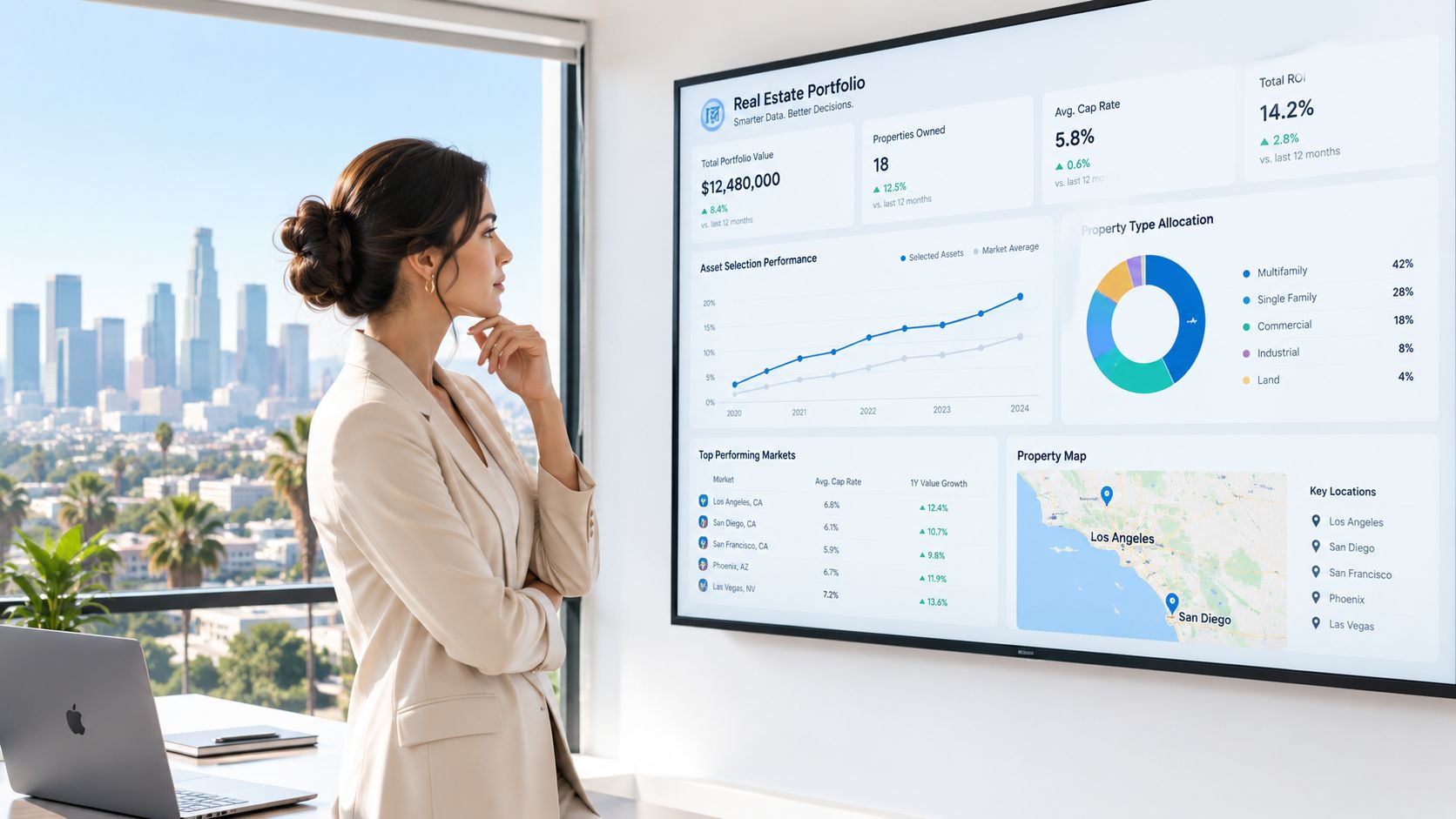
Institutional real estate has long treated performance as something that must be measured across assets, time periods, and market cycles. The NCREIF Property Index has tracked U.S. commercial real estate since the fourth quarter of 1977, and its coverage expanded from 233 properties worth about $6 billion in the first quarter of 1978 to 6,071 properties worth $269 billion by the first quarter of 2009. The index's historical record shows why professional analysis looks beyond occasional gains and evaluates consistent total return across cycles. The NCREIF primer also documents the early separation of office, industrial, and retail data, followed by apartments and hotels.
Residential markets tell a similar story, with a necessary warning about timing. A historical global dataset reports that real house prices rose 40% from 2000 to 2026, while the global real house price index reached 119.7 by 2019 and 132.8 in 2022, the highest level in that series. Those milestones support a practical conclusion for California agents: location and asset quality matter, but no label guarantees performance through every cycle. The global house price dataset provides the long-run context.
The agent's version of asset selection
For a residential professional, “asset selection” isn't limited to choosing an investment property. It includes choosing a submarket, identifying the client segment the agent can serve well, qualifying opportunities, and deciding which activities deserve limited time. A specialist who understands a small group of neighborhoods may create more value than a generalist who markets everywhere without local depth.
Current market commentary reinforces that distinction. Global listed data center real estate recorded a 31.6% year-to-date total return through August 2026, and specialty property represented 14% of 2025 global real estate deal volume, while data center deal volume rose 37% year over year, according to the cited market coverage. The market report also says asset selection explained about 70% of performance differentials in 2025, compared with less than 50% from 2020 through 2022. Those figures concern institutional markets, not residential commissions, but the lesson transfers: broad exposure matters less when execution and selection determine the outcome.
Practical rule: A high-performing agent can explain which clients, properties, neighborhoods, and service promises fit the business, then measure whether those choices produce healthy results.
Ashby & Graff can fit that systems-based approach as one brokerage option for California agents who want structured training, mentor support, flexible commission arrangements, and efficient transaction processes. The brokerage's relevance isn't a motivational slogan. It's the availability of infrastructure that lets an agent build a measurable practice across Los Angeles, Orange County, San Diego, and the Bay Area.
Setting Goals and Tracking KPIs That Drive Growth
A business plan becomes useful when it turns an annual ambition into actions that can be reviewed every week. “Close more business” isn't a KPI. It's an outcome. A working dashboard shows the activities that create opportunities, the conversion points where prospects are lost, and the financial result after expenses.
Institutional real estate uses value-weighted total return analysis because each asset influences the portfolio according to its monetary weight. Agents can adapt the principle without pretending that a sales pipeline is an investment index. High-value activities should receive more attention than raw activity counts, and results should be compared with a matched reference point rather than a vague industry average. MSCI's methodology standards explains the institutional logic behind total return, income and capital components, benchmark matching, and the risks of smoothed direct-property valuations.
Build the dashboard from the closing backward
Start with the desired number of closings for the planning period, then identify the required appointments, qualified conversations, and follow-up actions. The exact targets should come from the agent's own conversion history. A new agent can use a provisional baseline, but should revise it after enough activity reveals where the funnel is strong or weak.
| KPI | Weekly Target | How to Track | Benchmark Tip |
|---|---|---|---|
| New qualified conversations | Set from the agent's conversion history | CRM activity report | Compare by lead source, not only total volume |
| Follow-up completed | Match every active prospect's next action | CRM task completion | Review overdue tasks every week |
| Buyer or seller appointments | Derive from the closing goal | Calendar and CRM stage | Separate first appointments from repeat meetings |
| Showings or listing consultations | Use property and client fit to set the target | Transaction or calendar records | Track quality and next-step commitment |
| Offers or listing agreements | Set against qualified opportunities | CRM and transaction file | Compare accepted outcomes with preparation quality |
| Closed transactions | Use as a lagging measure | Brokerage and transaction records | Review by submarket and client type |
| Net commission available for reinvestment | Calculate after business expenses | Monthly financial report | Compare against the planned operating budget |
An agent should separate income-producing activity from business-building activity. A showing or consultation may lead directly to revenue, while a community partnership, market update, or client education event may build future opportunity. Both matter, but combining them into one activity count makes planning less accurate.
Review the numbers before the numbers become a problem
A fifteen-minute weekly review is enough if it follows the same sequence:
- Check new opportunities and the age of every unanswered lead.
- Review appointments held, appointments set, and the next action for each prospect.
- Identify one conversion failure, such as weak qualification or delayed follow-up.
- Check active transactions for missing documents, deadlines, or client communication.
- Move one resource, such as marketing time or training, toward the bottleneck.
Agents who want a clearer distinction between outcome measures and performance indicators can use strategic execution with OKRs and KPIs as a planning reference. The tool matters less than the discipline. A dashboard that nobody reviews is decoration.
Smoothing is another concern. One exceptional month can distort expectations just as one quiet month can create unnecessary panic. Review rolling patterns, source-level conversion, and the quality of completed work. The objective isn't to eliminate volatility. It's to make decisions using a fuller record than the latest closing.
Building a Lead Generation and Client Service System
A high-performance pipeline has two connected systems. The first creates qualified conversations. The second delivers a predictable client experience after someone raises a hand. Many agents build the first and neglect the second, then wonder why referrals remain inconsistent.
California prospecting works best when the mix reflects the agent's chosen market. An agent serving a Los Angeles neighborhood may combine open houses, past-client outreach, local content, and relationships with attorneys or relocation professionals. An Orange County specialist might add school-area education and move-up conversations. A San Diego agent may rely on community involvement and repeat buyers, while a Bay Area agent could build partnerships around relocation, technology employment, or complex seller preparation. The mix should be local and specific, not copied from a national template.
Assign every lead a next action
Lead capture fails when the form, CRM, calendar, and follow-up process don't connect. Each source needs an owner, a response standard, and a defined next step. The standard can be a call, a personal text, an email, or a scheduled consultation, but it must be visible in the CRM.
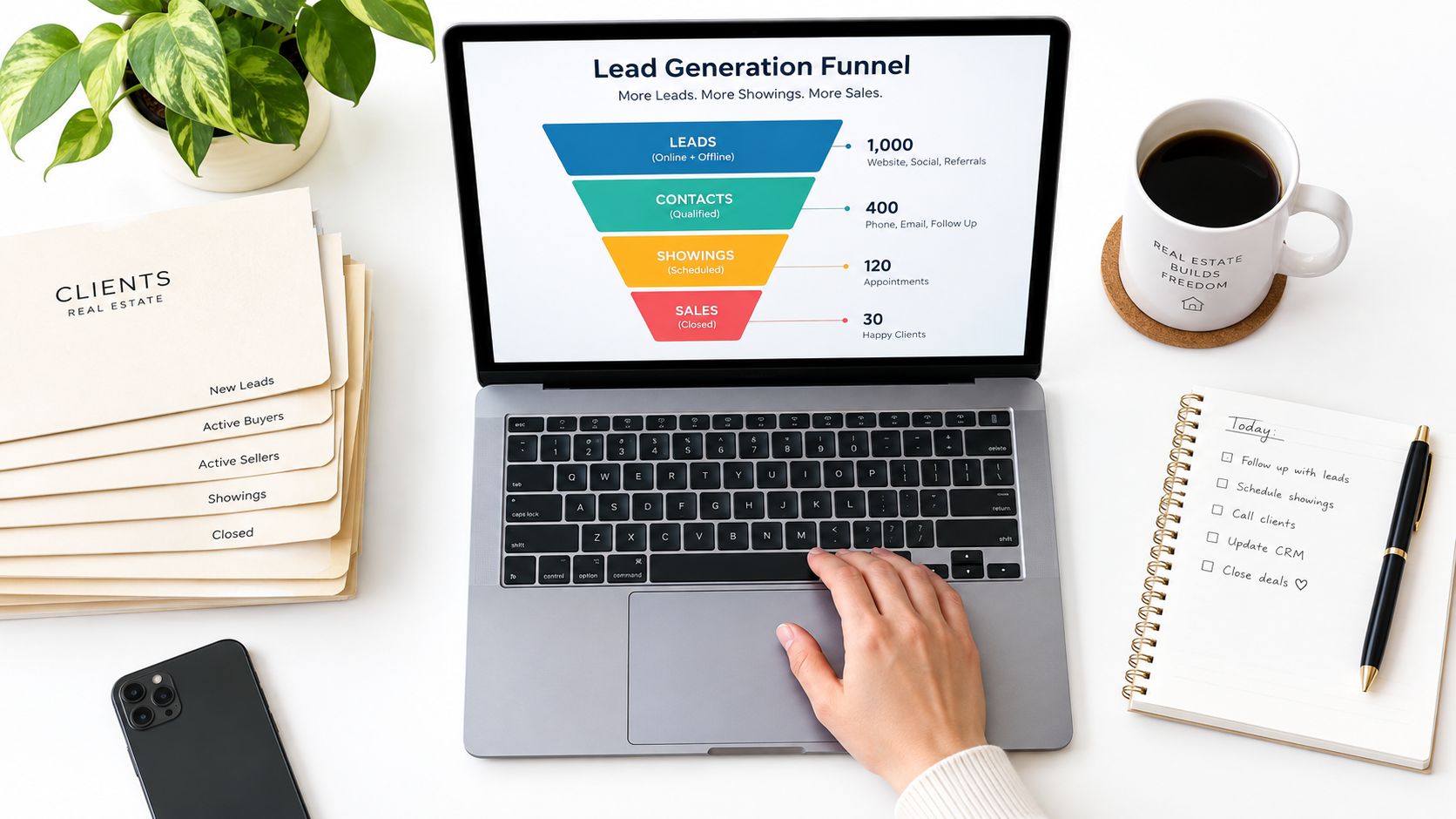
A practical funnel has these stages:
- New inquiry: Capture name, contact details, source, area, and stated need.
- Initial qualification: Confirm timing, motivation, financing or selling position, and decision participants.
- Nurture: Send relevant information, not a generic newsletter that ignores the prospect's situation.
- Appointment: Create a calendar commitment with an agenda and preparation checklist.
- Active client: Assign transaction, communication, and document responsibilities.
- Past client: Schedule useful, permission-based contact tied to the client's home and life.
Speed matters, but speed without relevance creates noise. A buyer asking about a condominium shouldn't receive a detached-home sequence for an unrelated neighborhood. A seller considering a future move needs education about preparation and timing before receiving pressure to list.
Use service checklists to protect trust
Client service should have a written rhythm. Before a listing appointment, the agent can confirm property facts, ownership details, goals, likely obstacles, and the materials required for a useful conversation. During escrow, the checklist should identify contract dates, inspection coordination, lender or title communication, disclosure follow-up, and scheduled client updates. After closing, the agent should confirm document delivery, answer practical ownership questions, and request feedback while the experience is still fresh.
The real estate lead generation strategies resource can support agents building that front-end pipeline. The important operating decision is to keep the process light enough to use daily. A complex funnel that requires constant manual rebuilding becomes a second job.
A checklist doesn't replace judgment. It protects judgment from being consumed by preventable omissions.
A broker, transaction coordinator, or mentor can help define service-level expectations and audit where opportunities stall. Ashby & Graff's training and transaction support can serve as one available structure for agents who want fewer disconnected handoffs. The system should still belong to the agent, with clear ownership of every relationship.
Branding Positioning and Keeping More of Your Commission
Branding and commission economics are often treated as separate conversations. They shouldn't be. A polished identity attracts attention, but the financial model determines how much capacity remains for lead generation, client service, education, and reserves.
An agent positioning a premium practice in the Bay Area needs more than luxury colors and a headshot. The brand should communicate a specific promise, such as complex seller preparation, relocation guidance, neighborhood expertise, or investor-minded analysis. In Los Angeles, the promise may need to work across several micro-markets without becoming vague. In San Diego and Orange County, a clear lifestyle or property specialization can help buyers understand why the agent is relevant.
Compare the brand promise with the economics
| Operating choice | What it can support | What can go wrong |
|---|---|---|
| Broad personal brand | More opportunities across locations and client types | Message becomes generic and difficult to remember |
| Focused submarket brand | Stronger local authority and more relevant content | Pipeline may narrow if the niche is too restrictive |
| Traditional split model | Familiar brokerage structure and possible office resources | Lower retained commission can limit reinvestment |
| Flat-fee arrangement | Easier forecasting when costs are clearly defined | Fixed obligations still need to be evaluated against production |
| Zero-split structure with transparent fees | More commission remains available for business use | Agents must budget for marketing, education, and support |
| Premium brokerage identity | More consistent presentation across channels | Design can outpace service quality if operations lag |
A zero-split model doesn't automatically create high performance. It creates a financial opportunity that only matters if the agent uses the retained commission intelligently. Reinvestment can fund photography, market-specific content, continuing education, client events, or administrative assistance. The right choice depends on support, compliance, transaction help, brand quality, and the agent's ability to manage an independent business.
Branding guidance for REALTORS® can help agents connect identity with a defined market position. The brand should make the next step obvious. If the audience can't tell who the agent serves, what problem gets solved, and why the process feels safer, visual polish won't repair the gap.
Treat retained commission as operating capital
Agents should forecast gross commission, brokerage costs, marketing, technology, education, insurance, taxes, and reserves before selecting a plan. Direct payment at escrow and transparent fees may improve cash-flow visibility, but only a written budget shows whether the structure strengthens the business.
Ashby & Graff offers flexible commission plans, zero broker splits with no hidden fees, direct payment at escrow, brand support, and agent resources as part of its California brokerage platform. Those features belong in a side-by-side evaluation with actual service needs, not in place of one.
Training Mentorship Tech Stack and Streamlined Operations
Technology doesn't create a high-performing practice by itself. A CRM full of incomplete records still produces missed opportunities. A transaction platform with no checklist still allows deadlines to slip. Training, mentorship, and technology work when they form one workflow, from learning a skill to applying it in a live client situation.
Build a learning rhythm around real deals
Training should cover negotiation, contracts, disclosure practices, pricing conversations, fair housing, and local market knowledge. Short, recurring sessions are easier to apply than occasional information overload. New agents benefit from role-play and file review. Experienced agents benefit from pressure-testing scripts, listing presentations, and negotiation plans against difficult scenarios.
Mentorship becomes valuable when it's available at the point of friction. A mentor can review an offer strategy before submission, help an agent organize a repair negotiation, or identify a compliance issue before it becomes a transaction problem. The relationship needs defined access and clear escalation practices, not just a general promise of support.
Choose integration over app accumulation
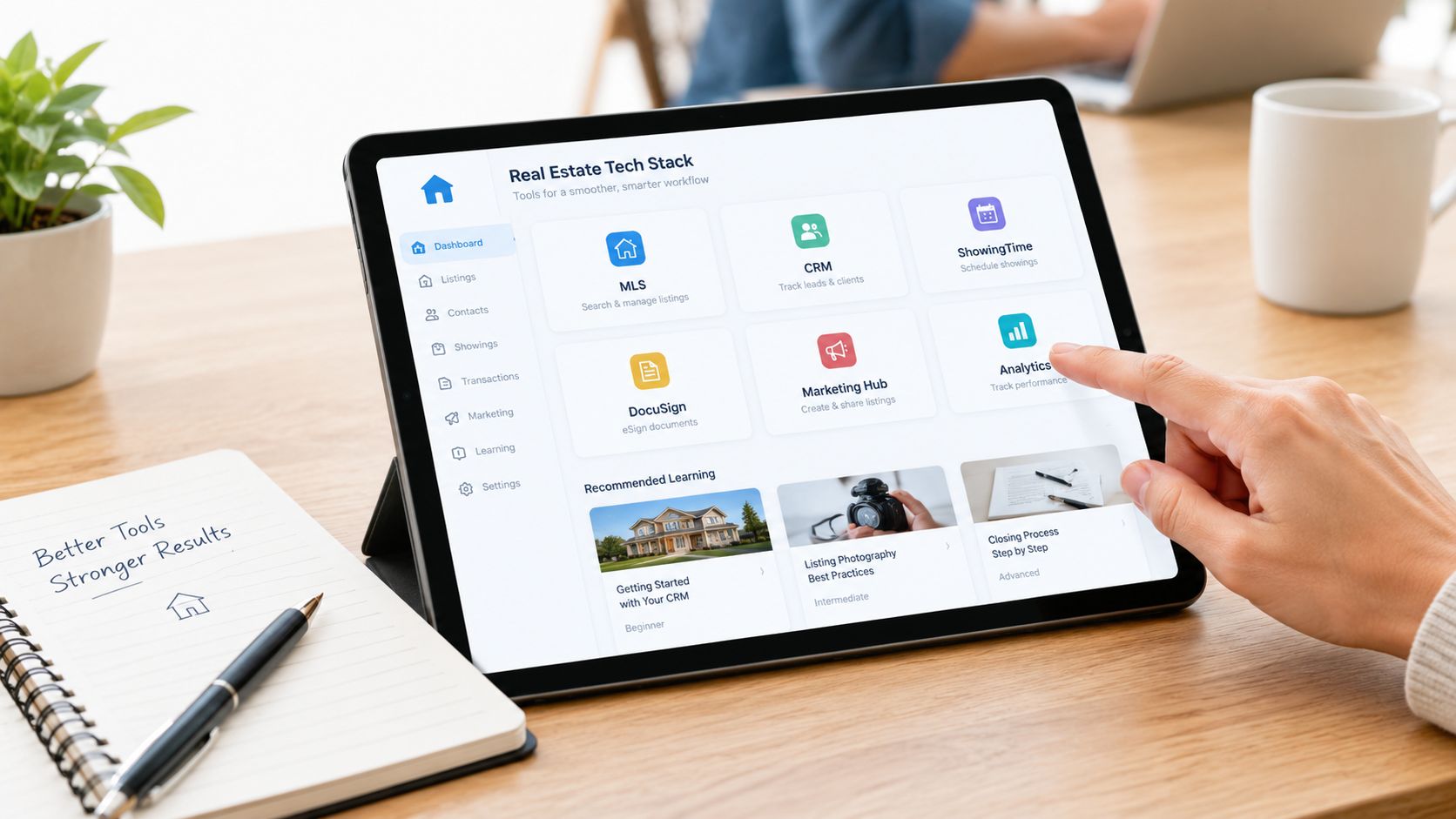
A lean stack usually includes:
- CRM: Contact records, lead source, stages, notes, and next actions.
- Transaction management: Documents, deadlines, approvals, and audit visibility.
- Marketing automation: Reusable emails, reminders, content distribution, and event follow-up.
- Calendar and communication: Appointment scheduling, confirmations, and client updates.
- Compliance workflow: Required forms, review points, and secure recordkeeping.
The test is simple. Can the agent enter information once and move it through the workflow without duplicate typing? Can a mentor or broker see what requires attention? Can the agent produce a clear client update without searching across several systems?
For teams organizing tasks across marketing, transactions, and accountability, Wisely's monday.com productivity guide offers a useful framework for thinking about centralized workflows. The platform choice is secondary to consistent ownership, naming conventions, permissions, and review habits.
Ashby & Graff's virtual brokerage model, training programs, certified mentorship, and broker support can provide another layer around this stack for California agents. The purpose is not to add more software. It's to reduce repeated work, keep compliance visible, and give agents a reliable place to get deal guidance.
Operating test: If a tool saves clicks but makes responsibility unclear, it isn't streamlining the business.
Standardize the parts that should be repeatable, including lead intake, appointment preparation, listing launch, escrow updates, and post-close contact. Leave room for judgment where client circumstances require it. That balance helps agents grow without turning personal service into a collection of disconnected automations.
Growing With Integrity Through Community and Next Steps
High performance real estate depends on trust that survives beyond a single transaction. An agent who gives equal attention to clients, explains decisions transparently, protects confidential information, and follows fair housing obligations builds a reputation that can outlast a market cycle. Community involvement strengthens that reputation when it provides genuine value rather than functioning as disguised self-promotion.
A useful community strategy starts with local relationships. Agents can collaborate with housing counselors, neighborhood organizations, small businesses, estate professionals, lenders, and contractors, provided the relationship remains compliant and transparent. Educational events about preparation, ownership responsibilities, or market changes can serve residents even when no immediate transaction follows.
Use a 30, 60, and 90-day reset
Days 1 through 30: Audit the database, define the ideal client and submarket, document the lead stages, and establish weekly KPI review. Remove duplicate tools and assign a next action to every active opportunity.
Days 31 through 60: Publish a consistent local education series, hold structured prospecting blocks, role-play negotiation and listing conversations, and create checklists for listing preparation and escrow communication. Review whether every client receives the same standard of responsiveness and explanation.
Days 61 through 90: Compare lead sources, appointment quality, transaction friction, client feedback, and net commission available for reinvestment. Keep the activities that create qualified relationships, revise the weak points, and confirm that marketing and service claims match the actual client experience.
The decision to change brokerages should follow the same logic. An agent should compare commission economics, hidden costs, broker access, mentor qualifications, training cadence, technology integration, transaction support, brand resources, and cultural alignment. A move makes sense when the new platform removes a documented constraint and supports a better service system, not because another plan sounds attractive.
Ashby & Graff's collaborative, integrity-driven model is designed for California agents who want brokerage support alongside flexible economics and practical resources. The strongest next step is a written comparison, followed by a direct conversation about onboarding, mentor access, transaction workflow, compliance, and the actual costs of operating the business.
Agents who want to turn high performance real estate principles into a practical operating system can review the training, mentorship, flexible commission plans, direct escrow payment, and California brokerage support available through Ashby and Graff. Visit the brokerage, compare the structure with the current business model, and schedule the conversation needed to build a more consistent practice in Los Angeles, Orange County, San Diego, or the Bay Area.