Low Real Estate Commission: Models, Costs, and Choices
A seller reviewing a listing agreement and a new agent reading a brokerage split offer can stare at the same question: Is this commission truly low, or does the number just move the cost somewhere else? A smaller percentage may reduce the bill, but it can also come with a minimum fee, separate buyer-representation payment, transaction charges, thinner marketing, or less broker support.
That's why a serious comparison can't stop at the advertised rate. Sellers need to examine the net amount left after every agreed cost, while agents need to compare what they keep with the training, supervision, transaction help, and business tools they receive. The useful question isn't “What's the lowest percentage?” It's “What services, obligations, and outcomes come with this price?”
What Low Real Estate Commission Really Means
A seller in California might receive one proposal that shows a reduced listing percentage and another that uses a flat fee. At the same time, a newly licensed agent might compare a traditional brokerage split with a zero-split plan and assume the latter automatically produces more income. Both are looking at a number before they've looked at the complete deal.
Low real estate commission is relative. It may mean a rate below the local norm, a fixed charge that remains predictable, or a brokerage plan that reduces the portion of an agent's commission paid to the broker. Those descriptions aren't interchangeable. A seller's listing fee and an agent's brokerage split sit on different sides of the transaction, even though both affect the money available at closing.
The percentage is only the first line
A listing rate answers one narrow question: how the listing side is compensated. It doesn't necessarily answer:
- Who pays for buyer representation?
- Does a minimum fee apply?
- Are photography, staging guidance, showings, and open houses included?
- Who handles transaction coordination and document deadlines?
- Will the agent pay separate marketing or technology charges?
- What happens if the agreement ends before closing?
A seller can save on the listing fee and still face a higher total cost if the contract adds charges or if weaker negotiation reduces the final proceeds. An agent can keep a larger share and still lose money if the brokerage provides little supervision and the agent must purchase every essential service separately.
Practical rule: A low headline rate is promising only after the complete service and cost package has been written down.
The comparison framework is straightforward. First, identify the total payment obligation. Next, list every included service and excluded expense. Finally, consider whether the arrangement gives the seller or agent enough support to avoid costly mistakes. By the end of that exercise, “low” becomes a measurable description rather than a marketing adjective.
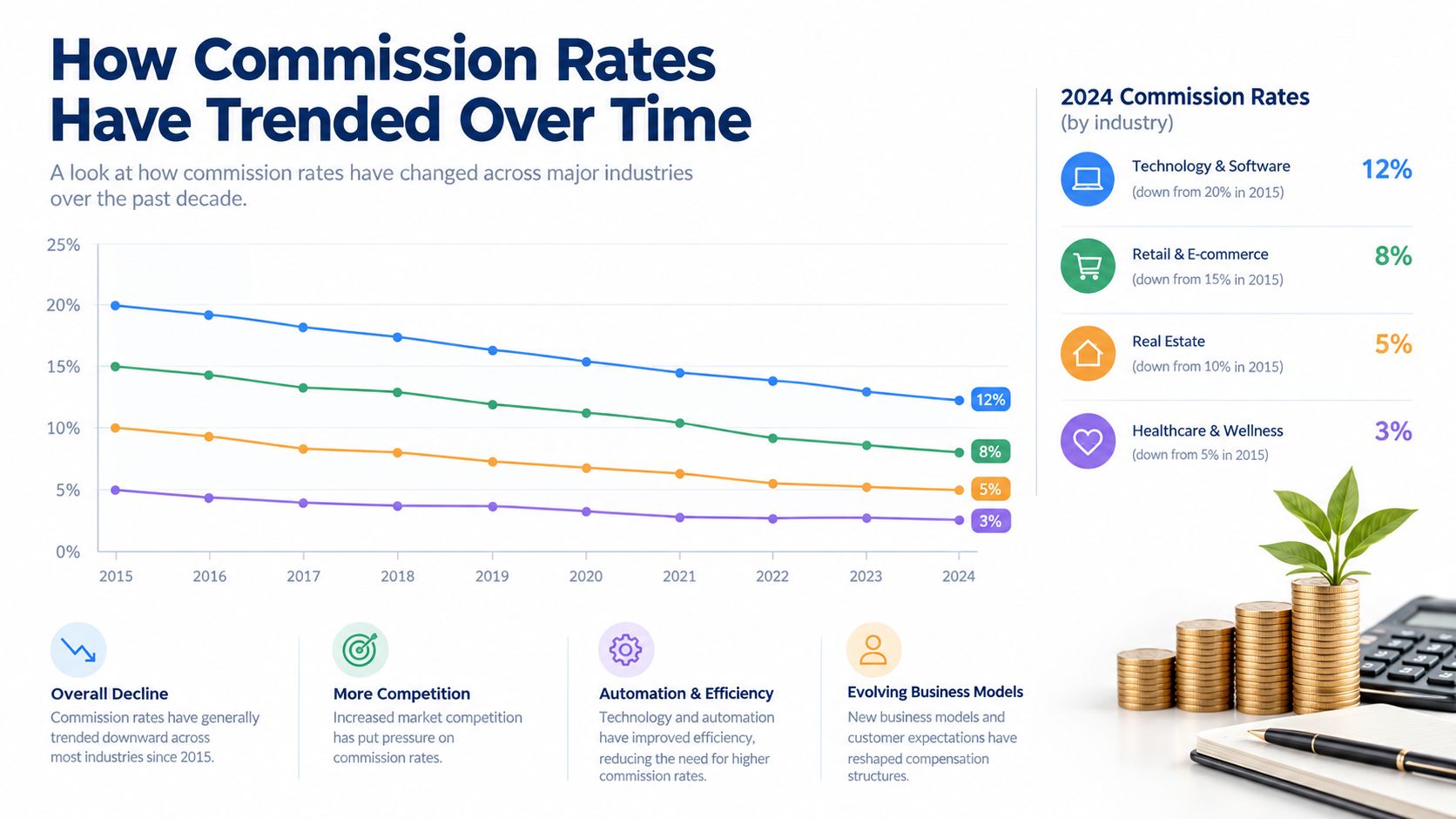
How Commission Rates Have Trended Over Time
Commission pricing didn't suddenly become flexible because of one recent policy change. The Federal Reserve's analysis of advertised buyer-agent compensation from 1995 through 2023 shows a long, gradual decline. The national average moved from approximately 3.0% in the late 1990s to about 2.7% in 2023, while advertised rates became more widely distributed across markets, including a range of roughly 2.0% to 2.5% in 2023. The Federal Reserve summarizes this history in its analysis of trends in real estate broker compensation.
The same source provides an earlier baseline from Government Accountability Office research. Average rates among major brokerage firms reportedly declined from about 5.5% in 1998 to 5.1% in 2003, a decrease of approximately 7%, while consumers paid an estimated $65.7 billion in residential brokerage fees in 2005. The lesson is counterintuitive but important: a lower percentage doesn't guarantee lower total industry revenue or a smaller dollar charge for every seller.
Why percentages and dollars can move differently
Suppose a commission percentage declines while property values and transaction activity rise. The percentage applied to each sale may be smaller, but the resulting dollar amount can still remain substantial. A seller therefore shouldn't compare a rate from a different decade without considering the property's sale price, the services attached to the fee, and the other compensation negotiated in the transaction.
That history also explains why low-commission models shouldn't be treated as a temporary exception. They grew from a sustained movement toward more varied compensation, not from a single event. A rate that seems unusually low in one California market may be ordinary in another, and a rate that looks attractive may provide little savings after minimums or separate charges.
The proper baseline has three parts:
- Local comparison, meaning what comparable agents currently offer in the same market.
- Service comparison, meaning what each proposal includes.
- Net-dollar comparison, meaning what the seller or agent pays or keeps.
A declining percentage can create meaningful savings, but the value depends on the complete transaction rather than the percentage printed at the top of a proposal.
How the Main Commission Models Work
Three structures appear most often in real estate: a percentage fee, a flat fee, and a zero-split or high-retention brokerage plan. Each resembles a different way of buying a meal. A percentage model is like a buffet where the bill rises with the size of the plate. A flat fee is a fixed menu price. A zero-split plan resembles a membership, where the professional pays for access to a platform and retains the commission under the plan's terms.
A hypothetical $700,000 California home makes the distinctions easier to see.
Percentage pricing
A listing agreement might use a percentage of the sale price. At a hypothetical 2% listing fee, the listing-side charge would be $14,000 on a $700,000 sale. At a hypothetical 3% rate, the charge would be $21,000. Those figures describe only the stated listing fee, not buyer representation or other transaction expenses.
Percentage pricing can work well when the seller wants a full-service relationship and the agreement clearly identifies marketing, negotiations, showings, paperwork, and closing support. The drawback is that the charge rises with the sale price, even when the agent's workload doesn't rise in direct proportion.
Flat-fee pricing
A flat fee sets the listing charge in advance. If the agreed fee were $10,000, the listing-side charge would remain $10,000 whether the property sold for more or less than expected, subject to the contract's terms. That predictability can help a seller budget, but the agreement must explain whether the fee covers professional photography, MLS placement, open houses, negotiation, transaction coordination, and post-inspection support.
A flat fee can also include exclusions or additional charges. The seller needs the complete fee schedule, not just the advertised base amount.
Zero-split brokerage plans
A zero-split plan applies to the agent's relationship with the brokerage, not automatically to the seller's listing fee. Under a plan of this kind, an agent may retain the full commission received under the transaction agreement while paying a transaction charge, monthly fee, or other stated cost. On a hypothetical $14,000 commission, the agent's take-home amount depends on those plan charges and any marketing or compliance expenses.
The critical comparison is whether the brokerage supplies mentorship, training, transaction review, lead-generation resources, and operational support. An agent who keeps more of the gross commission but must independently pay for every tool may not improve net income.
For a practical breakdown of different agent and brokerage arrangements, the commission structure examples can help separate gross commission from actual take-home pay.
What Changed With the 2024 Compensation Rules
The compensation conversation changed materially on August 17, 2024, when policy changes associated with the National Association of REALTORS® settlement took effect. Offers of buyer-agent compensation could no longer be displayed in MLS fields, and agents working with buyers were required to enter written agreements before touring homes in jurisdictions applying the requirement. The North Carolina Real Estate Commission describes these changes and notes that NAR agreed to pay $418 million to resolve the underlying litigation in its explanation of the settlement and commission rules.
Before the change, compensation was commonly “coupled.” Sellers often offered an amount intended to cover both the listing agent and buyer's agent, with total charges historically cited in the approximate 5% to 6% range. Under the revised framework, buyer-agent compensation can still be negotiated separately outside the MLS, but it can't be treated as an automatic MLS-displayed term.
Written terms now carry more weight
A buyer agreement must identify compensation that is objectively ascertainable. A vague promise to determine payment later doesn't give either side a reliable understanding of the obligation. Before touring homes, the buyer and agent need to address the service scope, payment method, duration, cancellation terms, and whether the seller may offer a concession or other contribution.
That requirement changes how low-cost representation should be presented. A buyer agent can't rely on a customary seller-paid amount. The agent must explain the value of the service and document the agreed compensation. The seller, meanwhile, needs to decide whether a contribution toward buyer representation supports access to qualified buyers in the property's market.
Compliance becomes part of the value proposition
A low-commission model now requires more than a competitive price. It needs standardized disclosures, accurate agreements, transaction checklists, and negotiation training. If an agent advertises a reduced rate but can't explain who pays, when payment is due, or what services are included, the low number creates confusion instead of value.
Consumers considering a buyer-side rebate or related arrangement should also understand the distinctions among compensation, concessions, and brokerage policies. A plain-language overview of real estate commission rebates can help clarify the questions that should be answered before an agreement is signed.
Trade-Offs for Sellers and Agents
Could a lower commission leave a seller with more money while making a buyer's purchase harder to complete? Sometimes. The answer depends on the full transaction, including who pays for representation, what services are included, and whether the reduced fee changes the final sale price or concessions.
An NBER analysis of post-settlement housing markets models how lower transaction costs can raise housing values over time. Current homeowners receive most of the gains in that model, while financially constrained and first-time buyers may face greater difficulty. A lower fee can therefore shift costs without removing them.
That issue matters when a seller decides whether to offer buyer-agent compensation. A buyer may afford the home but lack enough cash to pay representation at closing. The seller's choice can affect which buyers can realistically compete.
The seller's calculation
A seller should compare the fee reduction with its possible effect on buyer access, negotiation, and final proceeds. The Consumer Federation of America survey cited in the NBER discussion found that 53% of housing counselors said sellers now “never,” “rarely,” or only “sometimes” cover buyer-agent fees. Only 9% commonly saw transactions fail because buyers could not afford commissions at closing. The findings support a careful comparison, not a rule that sellers must always pay or never contribute.
Potential advantages for sellers
- Lower stated expense: A reduced listing fee can increase proceeds if the service level and sale price remain comparable.
- More pricing flexibility: Savings may go toward repairs, preparation, concessions, or moving expenses.
- Clearer negotiation: Separate compensation terms can make each financial choice easier to evaluate.
Possible costs
- Reduced buyer access: Some buyers may not have enough cash to pay representation separately.
- Weaker bargaining position: An agent with limited time or resources may provide less help during inspection, appraisal, or repair negotiations.
- Lower net proceeds: A modest fee saving can disappear if the property sells for less or requires larger concessions.
The agent's calculation
For agents, a high split is only one part of the offer. Calculate the net commission after transaction charges, monthly fees, marketing, licensing, errors-and-omissions coverage, and support expenses. A brokerage plan can leave an agent with a larger percentage while producing a weaker business if difficult files lack review from an experienced broker or reliable transaction coordinator.
A useful test: Savings win when the retained money exceeds the value of the service, access, and negotiation capacity sacrificed to obtain it.
Career stage also changes the calculation. A seasoned producer with strong systems may work effectively under a lean model. A new agent may need structured mentoring, contract review, role-play training, and compliance support before a high-retention plan becomes economical. The headline split is only useful after those costs and services are itemized.
How to Compare Commission Offers Beyond the Headline Rate
Negotiation is becoming more common, but the market hasn't settled on one universal price. 37.4% of U.S. sellers surveyed by Ipsos in March and April 2025 said they negotiated or tried to negotiate their agent's commission, according to reporting on the 2025 commission market. The same source reports that the share of agents seeing at least some sellers unwilling to cover buyer-agent compensation rose from 27% in August to 32% in February 2025.
Those figures don't prove that the cheapest proposal is the right proposal. They show that consumers are asking more questions, while compensation responsibilities remain uneven from one transaction to another.
A seller or agent can use the following checklist before comparing percentages.
| Comparison Criterion | What to Ask | Why It Matters |
|---|---|---|
| Included services | Does the fee include pricing analysis, photography, MLS entry, showings, open houses, negotiation, and closing coordination? | A lower fee may describe a narrower service package. |
| Buyer representation | Who pays the buyer agent, and can the seller offer a concession or separate contribution? | The listing fee doesn't settle the buyer-side obligation. |
| Minimum or cancellation fee | Is there a minimum payment, early cancellation charge, or protection period? | A minimum can raise the effective cost on a lower-priced sale. |
| Transaction coordination | Who tracks deadlines, disclosures, inspections, repairs, and escrow communication? | Administrative gaps can create delays and compliance risk. |
| Training and broker support | Can the agent obtain contract review, mentoring, negotiation coaching, and compliance help? | Retained commission has less value if the agent must purchase essential support elsewhere. |
| Marketing expenses | Are staging guidance, photography, video, signs, digital promotion, and print materials included? | Separate marketing charges change the true cost. |
| Payment at closing | Who receives payment, when is it disbursed, and which charges are deducted first? | The gross commission isn't the same as the agent's or seller's net amount. |
Build an itemized net comparison
For a seller, start with the expected sale proceeds. Subtract the listing fee, agreed buyer-side contribution, concessions, transaction charges, and any preparation expenses that the proposal assigns to the seller. Then evaluate the agent's pricing strategy, communication plan, negotiation process, and availability.
For an agent, start with the commission shown in the transaction agreement. Subtract the brokerage split or plan fee, transaction charge, marketing costs, licensing-related overhead, referral obligations, and any service purchased independently. This calculation reveals whether “100% commission” means true high retention or a different bundle of expenses.
A commission calculator for real estate apps can help organize the arithmetic, but it can't judge service quality or contractual risk. The calculator should support the conversation, not replace a careful review of the agreement.
Ask for answers in writing
The strongest proposal identifies each service, cost, and payment condition before the relationship begins. If a representative says a charge is “usually waived” or a service is “normally included,” the final agreement should state that clearly. Verbal assumptions are especially dangerous when buyer-agent compensation and seller concessions are being negotiated separately.
A low rate becomes meaningful only when the itemized comparison shows that the client or agent will pay less without losing support that protects the transaction.
Next Steps for California Sellers and Agents
California's major markets, including Los Angeles, Orange County, San Diego, and the San Francisco Bay Area, make commission decisions especially consequential because a percentage applies to a high-value asset. The right approach still begins with the same disciplined review, regardless of whether the property is urban, suburban, coastal, or inland.
A short process for sellers
Sellers can request written proposals from multiple agents and ask each one to provide the same information:
- Listing compensation: State the percentage or flat fee, minimum charge, and cancellation terms.
- Buyer-side terms: Explain whether the seller may offer a contribution and how it would be documented.
- Service schedule: List photography, marketing, showings, negotiation, disclosures, transaction coordination, and escrow support.
- Net proceeds: Show how each expected charge affects the seller's estimated proceeds.
- Negotiation plan: Describe how the agent will handle offers, inspection requests, repairs, credits, and appraisal issues.
The best proposal isn't necessarily the one with the smallest first number. It's the one that makes the final obligation easy to understand and gives the seller a credible plan for protecting price and deal certainty.
A short process for agents
Agents comparing brokerages should request a written fee schedule and calculate take-home pay across several likely transaction types. The review should include transaction charges, monthly costs, marketing obligations, direct escrow payment, contract review, mentoring, training, lead-generation tools, and the broker's availability when a file becomes complicated.
A zero-split, no-hidden-fee model such as Ashby and Graff can fit this framework when an agent wants to retain the full commission while still evaluating the plan's transaction costs and support structure. Its California brokerage model provides flexible commission plans, certified mentors, training, transaction processes, and resources for agents in Los Angeles, Orange County, San Diego, and the Bay Area. The agent still needs to read the current agreement and compare every charge against the support received.

The seller at the opening of this guide and the new agent evaluating a brokerage plan need the same discipline. Both should replace the question “Is this rate low?” with “What does this arrangement cost, what does it include, and what outcome can it support?”
Ashby and Graff offers California agents flexible commission plans, zero broker splits, no hidden fees, mentorship, training, and transaction support designed to help professionals retain more of their earned commission. Agents in Los Angeles, Orange County, San Diego, and the Bay Area can review the model and compare it with their current brokerage by visiting Ashby and Graff.