
What Is Business Planning for Real Estate Agents
Three weeks after getting licensed, many new agents are already busy all day and still can't say whether the business is moving forward. One online lead needs a callback. An open house opportunity pops up for the weekend. A cousin wants advice about buying next year. Family obligations cut into the evening. The calendar fills up, but the pipeline stays foggy.
That's usually the moment the question shows up. What is business planning? For a real estate agent, it isn't a corporate document written for a bank folder. It's the set of decisions that turns random activity into a repeatable business.
The easiest way to understand it is to stop thinking about planning as theory. A plan starts with a target income, works backward into the number of closings needed, then breaks that into appointments, conversations, and leads. For an agent in California, that plan also has to reflect local pressure points like commission splits, marketing costs, and the need for broker support while learning the business.
Why New Real Estate Agents Need a Plan From Day One
A new agent's first month often looks productive from the outside. The phone rings. Social media messages come in. Another agent asks for open house coverage. A friend says a neighbor might sell in the fall. Every item feels urgent, so the agent says yes to everything.
By the end of the week, the agent has been busy but not deliberate. That's the difference a written plan fixes.
Busy isn't the same as building a business
Without a plan, each day becomes a reaction test. The agent follows whatever appears first instead of deciding in advance which work matters most. In real estate, that usually means too much time spent on low-probability activity and not enough time spent on lead follow-up, database building, or appointment setting.
A plan changes the order of decisions. It asks a new agent to choose a market, choose a lead source, and choose a number. Once those choices are written down, the workday gets simpler. The agent can look at a task and ask, “Does this help the plan, or just fill the day?”
Practical rule: If an agent can't explain how a task connects to closings, referrals, or future pipeline, that task probably belongs lower on the calendar.
California makes wasted effort expensive
This matters everywhere, but it matters even more in California. New agents often face high operating costs, uneven income, and pressure from traditional commission splits that reduce what they can reinvest into lead generation and training. One wasted weekend open house, one poorly chosen ad campaign, or one month without consistent follow-up can cost more than it first appears.
Planning also helps with something many rookies underestimate. Starting a real estate business comes with real setup expenses, and reviewing a practical guide to startup costs for new founders can help an agent think through early cash needs before the first commission check arrives.
A written plan isn't bureaucracy. It's a simple operating tool that improves the odds of getting traction. Entrepreneurs with a business plan are reported to be 152% more likely to launch, businesses with a formal plan grow 30% faster, startups with a complete plan are 2.5x more likely to secure funding, and plan-driven startups are 16% more likely to achieve viability, according to Upmetrics' summary of business plan statistics.
For a new agent, that translates into a plain lesson. The plan isn't paperwork before the work. It is the work.
The Five Building Blocks of Every Real Estate Business Plan
A real estate business plan works best when it's built like a house. If one wall is missing, the whole structure feels unstable. New agents usually need five blocks in place before the math starts to make sense.

Vision and income target
The first block is the clearest one. The agent picks an annual gross commission income target and connects it to personal life. Rent, savings, taxes, marketing money, and a basic monthly draw all live here.
Without that number, everything else floats. A plan that says “grow the business” is too vague to manage. A plan that says “produce enough gross commission income to cover living costs and leave room to reinvest” can guide daily choices.
Market and niche
The second block answers where and with whom the agent plans to work.
That might mean first-time buyers in the Inland Empire, condo sellers in Long Beach, move-up families in Orange County, or investors in parts of the Bay Area. A niche doesn't trap an agent. It gives the agent a center of gravity. Marketing gets clearer, scripts get sharper, and referrals are easier to ask for when people know exactly what kind of business the agent is building.
Lead generation mix
The third block is the fuel system. A business plan should identify the handful of lead channels the agent will work, such as:
- Sphere and database: Family, friends, past coworkers, and community relationships.
- Open houses and neighborhood work: Face-to-face visibility in a defined farm.
- Prospecting sources: FSBOs, expireds, referrals, online inquiries, and follow-up lists.
A plan becomes much more useful when each source is tracked separately. One industry guide recommends a rolling 12-month view and measuring the funnel by source, from lead to contacted lead to appointment set to closed transaction, because blended averages can hide which channels are profitable and which only create noise, as described by Club Wealth's lead planning guide for real estate agents.
Budget and commission math
The fourth block is where many new agents get surprised. Gross commission income is not take-home pay. Software, signs, lockboxes, association fees, mileage, photography, client gifts, marketing, and transaction expenses all come after the headline number.
This block should show what the agent keeps, what the agent spends, and what the business can afford to reinvest.
Metrics and accountability
The fifth block keeps the plan alive. A business plan without a scoreboard turns into a wish list.
Useful metrics often include:
- Lead count: How many new opportunities entered the pipeline.
- Conversations held: How many people the agent spoke with.
- Appointments set: The bridge between prospecting and business.
- Agreements signed or escrows opened: Proof that the pipeline is converting.
- Review rhythm: A standing check-in with a mentor, broker, or accountability partner.
A strong plan doesn't live in five separate documents. It connects one income target to one market, one lead mix, one budget, and one review rhythm.
Working Backward From Income Goal to Leads Needed
A new California agent sits down in January and writes, “I want to make $120,000 this year.” That goal sounds clear until Monday arrives and a question shows up. How many people does that agent need to meet, follow up with, and convert for that number to become real?
Business planning gets easier once you reverse the math.
Start with income, then figure out how many closings it takes
Use a simple example. If the annual goal is $120,000 in gross commission income, the first step is to estimate how much one closed side is worth in the market the agent plans to serve.
Say the target farm has an average sale price of $700,000, and the agent earns 2.5% on one side of the deal. One closing would produce $17,500 in gross commission income before any split, fees, or business costs. At that level, the agent needs about 7 closed sides to reach roughly $120,000 GCI.
That shift matters. “Earn six figures” is a wish. “Close 7 sides” is a target you can build a calendar around.
Next, turn closings into leads
Here is the part many new agents never get shown. Closed deals sit at the bottom of the funnel, but the work starts at the top.
A practical beginner benchmark is to assume that only a small share of new leads will become closings. Using a 2% to 3% conversion baseline for new agents, as referenced in the SBA-linked small business reference PDF, 7 closings can require a much larger lead pool than a first-year agent expects.
| Step | Assumption | Number |
|---|---|---|
| Income target | Annual GCI goal | $120,000 |
| Average sale price | Chosen farm example | $700,000 |
| Gross commission per side | 2.5% of sale price | $17,500 |
| Closed sides needed | $120,000 divided by $17,500 | about 7 |
| Lead conversion baseline | New agent benchmark | 2% to 3% |
| Leads needed at 3% | 7 closings divided by 0.03 | about 234 |
| Leads needed at 2% | 7 closings divided by 0.02 | 350 |
That table gives the goal some weight. Seven closings may sound manageable. 234 to 350 leads shows the actual workload behind it.
Put the yearly number into monthly and weekly terms
Big annual targets can feel abstract, so break them down.
A range of 234 to 350 leads a year works out to about 20 to 30 leads a month. That is roughly 5 to 8 leads a week. For a new agent, that could come from open house sign-ins, sphere outreach, online inquiries, renter conversations, community events, and referral requests.
Then go one step lower. If only part of those leads answer the phone or reply to a text, the agent may need to make far more outreach attempts than the lead count suggests. A plan works like a flight plan. The destination matters, but so do the checkpoints along the way.
Add a conversation goal, not just a lead goal
Leads by themselves can fool a new agent. A spreadsheet with 30 names looks busy. A week with 12 real conversations is usually more useful than a week with 40 cold names and no follow-up.
For that reason, many agents plan backward in four layers:
- Income goal: the annual GCI target
- Closed sides: the number of transactions needed
- Active opportunities: people in conversation, showing, or appointment stages
- Lead and contact activity: new leads generated and follow-up conversations completed
A simple version might look like this: if an agent wants 7 closings for the year, that agent may decide to aim for 2 to 3 new leads a week, plus a set number of follow-up calls and texts every day, then review whether those contacts are turning into appointments.
Why this matters more for new California agents
A first-year agent does not just need math. That agent needs a way to test the math against real conditions.
In California, price points, competition, and marketing costs vary fast from one area to another. An agent working inland at a lower average sales price may need more closings than an agent in a higher-priced coastal market to reach the same income target. That is where mentorship and brokerage support start to matter. A broker or mentor can help a new agent pressure-test the assumptions: Is $700,000 a realistic average price for this farm? Is 2.5% realistic for the business mix? Is the lead goal high enough for a first-year pipeline?
Without that reality check, a plan can look tidy on paper and still miss the market.
A real estate business plan starts to work when an income goal turns into a weekly quota for leads, conversations, and appointments.
How Commission Structure Shapes Your Planning Budget
Two agents can close the same sale and leave the transaction with very different business capacity. That's why commission structure belongs inside business planning, not off to the side.
In California, this decision often determines how much money an agent can put back into lead generation, software, and support.
One sale can fund next month's pipeline or starve it
Use a straightforward example. On a $400,000 sale at 2.5% commission, the gross commission is $10,000 on that side.
Under a traditional 70/30 split, the agent keeps $7,000 before business expenses. Under a flat $500 per-side fee model, the agent keeps $9,500 before business expenses. The difference is $2,500 on one transaction.
| Category | 70/30 Traditional Split | $500 Flat-Fee Per Side |
|---|---|---|
| Sale price | $400,000 | $400,000 |
| Gross commission at 2.5% | $10,000 | $10,000 |
| Brokerage cost | $3,000 | $500 |
| Agent keeps before expenses | $7,000 | $9,500 |
That gap matters because planning is about execution capacity. Extra retained commission can fund more prospecting and cleaner systems.
The plan has to reflect what the agent actually keeps
With the higher retained amount, an agent may be able to allocate more toward the business without choking personal cash flow. Common planning buckets include:
- Marketing reserve: Many agents set aside part of each commission check for ads, farming, signs, and client touches.
- Software stack: CRM, e-signature tools, design tools, scheduling, and transaction support can add up quickly.
- Coaching and training: Script practice, role-play groups, and broker-led review can improve consistency.
- Cash cushion: Real estate income is uneven, so reserves matter.
Across multiple transactions, the structure compounds. If the same difference holds over ten similar deals, the retained spread approaches $25,000. That's not just income. It's business fuel.
A new agent doesn't need the cheapest model or the fanciest one. The agent needs a model that leaves enough room to execute the plan with discipline.
Designing a 12-Month Rolling Plan With Quarterly Milestones
Many agents write goals in January and don't look at them again until summer. A rolling plan works better because real estate doesn't move in neat annual blocks. Pipeline timing shifts, listings stall, buyers pause, and personal capacity changes.
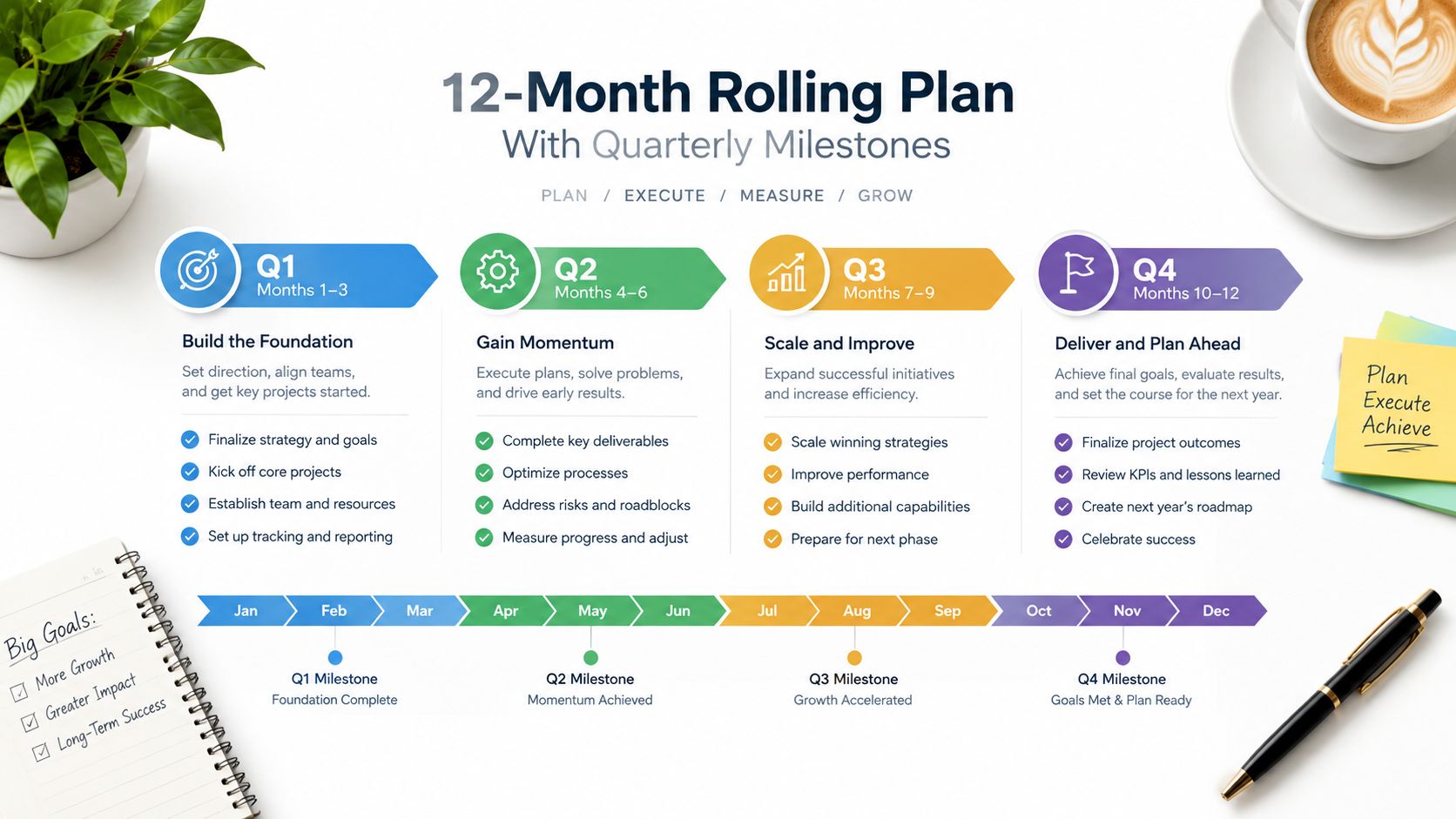
A useful way to build that rhythm is to map the next 12 months, then review it every quarter instead of waiting for a calendar reset. Agents who want a worksheet to organize those pieces can use a real estate agent business plan template as a starting structure.
A simple quarterly rhythm
Each quarter should have one job.
- Q1 foundation: Set up CRM fields, define the farm or niche, organize the sphere list, and start a regular contact plan.
- Q2 pipeline build: Add open houses, experiment carefully with lead sources, and tighten follow-up habits.
- Q3 conversion push: Focus on consultations, client service, and improving presentation skills so activity turns into signed business.
- Q4 expansion: Reconnect with clients and warm prospects, review what worked, and build the next rolling year from current data.
This rhythm keeps the plan tied to actual development stages instead of vague motivation.
Monthly reviews matter more than yearly declarations
Business planning works better when the agent checks leading indicators, not just income totals. A monthly review might include:
- Lead sources reviewed separately: Which channels are producing conversations and appointments
- Appointment pipeline: Whether prospecting is turning into real meetings
- Pending and closed business: Whether current effort is likely to pay off in the next few months
- Capacity notes: Whether the agent can keep up with follow-up, client care, and admin
A rolling plan doesn't ask, “How did the year go?” It asks, “What has to change this month so the next ninety days improve?”
That flexible approach fits current planning reality. Recent FP&A survey findings report that 44% of organizations can only plan with high confidence up to 3 months out, and the same report notes projected 2025 adoption of cloud-based financial tools in the 59% to 67% range while 96% of finance teams still use Excel, according to OneStream's FP&A trends survey summary. For a solo agent, that supports a practical lesson: shorter review cycles usually beat a rigid annual plan.
Why a Business Plan Should Be a Living Document, Not a One-Time Task
A static business plan goes stale fast in real estate. Market inventory changes. Buyer urgency changes. Personal bandwidth changes. An agent who writes a plan once and shelves it usually drifts without noticing.

That's why the better answer to what is business planning is this: it's an operating system. It should absorb new information and force small corrections before a weak month becomes a weak quarter.
What a living plan actually looks like
A living plan doesn't need to be complicated. It needs a review habit.
A simple monthly check can cover four things:
- Lead cost and source quality: Which channels are worth keeping
- Conversion slippage: Where prospects are stalling in the funnel
- Expense drift: Whether recurring costs are creeping up
- Capacity strain: Whether the agent is dropping follow-up or overbooking
A quarterly reset can go one layer deeper. The agent can decide whether to narrow the niche, cut one weak lead source, improve listing practice, or outsource a task that keeps interrupting production.
Planning has shifted toward adaptability
Small-business planning has also moved toward resilience, not just growth. In 2025 SMB trend data, 63% prioritized profitability, 62% prioritized growth, 70% planned to increase outsourcing, 69% were using or planning to use AI for expansion, and another finding reported 85% of finance leaders were enthusiastic about AI in financial operations, according to Clutch's 2025 small business growth report.
That doesn't mean every agent needs a complicated tech stack. It means the plan should reflect real capacity. If a solo agent can't manage every lead source well, the answer may be fewer channels, better follow-up, and selective outsourcing.
The plan should change when the facts change. The agent who updates it quickly usually protects both income and sanity.
Putting the Plan Into Action With Mentorship and Brokerage Support
A finished plan on paper still needs a person and a system behind it. That's where many new agents stall. They know the target, but they don't yet know whether their scripts are weak, whether their follow-up is too slow, or whether their pipeline numbers are normal for a beginner.
Mentorship closes that gap faster than solo trial and error. A new agent benefits from shadowing listing appointments, practicing objection handling out loud, and reviewing weekly conversion numbers with someone who can spot where the funnel is leaking. A practical discussion of that learning curve appears in this article on the role of mentorship in real estate growth.
Brokerage support matters for the same reason. The office or virtual platform shouldn't only provide a logo and transaction processing. It should help an agent turn a plan into routine behavior through onboarding checklists, accountability, market guidance, and access to proven tools. In that context, resources such as business-plan outlines, coaching, and peer masterminds can give structure to the first year without pretending the work becomes easy.
Ashby & Graff is one example of a California brokerage model that provides planning resources, training, and mentor access alongside flexible commission structures. For a new agent, the value of that kind of support is simple. It shortens the distance between writing the plan and living it.
The strongest first step is small and immediate. Within the next seven days, the agent should schedule one planning conversation with a broker or mentor and bring three items: the income target, the intended market, and the current lead sources.
Ashby & Graff gives California agents practical support that fits this kind of planning work, including training, mentorship, business-planning resources, and flexible commission structures that affect how much an agent can reinvest in growth. Agents who want a clearer path from income goal to daily execution can visit Ashby and Graff and explore whether the brokerage's model matches the business they're trying to build.